Month: September 2026

  • When Words Fail: Shams Tabrizi on the Mystery of Spiritual Experience

    When Words Fail: Shams Tabrizi on the Mystery of Spiritual Experience

    What happens when a spiritual experience becomes too profound for words? Shams Tabrizi explores the limits of language, silence, and the mysterious distance between what the heart experiences and what the tongue can express.

    There are experiences that language does not merely struggle to describe; language seems almost incapable of approaching them at all. A person may encounter something within that changes the way they see life, yet when they try to convey what they have seen to others, they discover that words are narrower than the experience itself, and that what was lived in a single moment cannot be reduced to a handful of sentences.

    It is with this sense of inadequacy that Shams Tabrizi expresses one of the deepest problems of spiritual experience: how can someone who has tasted something within the depths of the self describe it to someone who has never tasted it? He writes:

    «من گُنگِ خواب‌دیده و عالم تمام کَر
    من عاجزم ز گفتن و خلق از شنیدنش»
    «I am a speechless one who has seen a dream, while the whole world is deaf;
    I am unable to speak of it, and people are unable to hear it.»

    Shams is not speaking here of an ordinary inability to speak. He is speaking of the distance between experience and meaning, between what is lived and what can be said. The mystic may possess an experience that cannot be completely transformed into language, while the listener may hear the words without ever reaching the reality that lies behind them.

    From this perspective, the verse opens a wide door into the nature of mysticism, the limits of language, and the reason why inward experience in Sufi literature has so often been expressed through silence, suggestion, metaphor, and symbol rather than through direct explanation.

    When the Heart Sees What Language Cannot Say

    Shams begins with a simple yet profound paradox: a person may undergo an experience that is perfectly clear within, only to discover that it becomes almost impossible to communicate to another person. The seeing in this context is not the seeing of the eyes, but an inward vision connected with knowledge, awareness, and transformation.

    That is why he compares himself to someone who has seen a dream but cannot speak of it. The dream is present in his memory, perhaps filled with images, meanings, and emotions, yet he cannot fully recount it. The problem is not the absence of experience; it is the absence of language capable of carrying the experience across the distance between one soul and another.

    From Experience to Words: Where Does the Truth Get Lost?

    Words can convey meanings, but they cannot transmit an experience itself. A person can describe love, fear, wonder, annihilation, or serenity, yet describing these things does not necessarily allow the reader to experience them.

    Here lies one of the central questions of mysticism: the difference between knowing something through words and knowing it through direct experience.

    Speaking about honey is not the same as tasting honey, just as speaking about light is not the same as seeing it. In the same way, a person may read dozens of books about spiritual experience without necessarily coming any closer to the experience those books attempt to describe.

    Why Does Silence Sometimes Speak More Than Words?

    In Sufi literature, silence does not necessarily signify an absence of knowledge. It can instead be the consequence of an experience so full that language becomes inadequate to contain it. When an experience becomes wider than the capacity of speech, silence itself can become another form of expression.

    This is why Sufi writers so often turn to poetry, metaphor, stories, symbols, and indirect language: ordinary speech may be too narrow to express what is happening within.

    “The Whole World Is Deaf”: The Problem of the Listener, Not Only the Speaker

    Shams does not stop by saying that he is unable to speak. He adds that the world itself is unable to hear.

    This distinction is crucial, because the problem does not always lie in the words. The words may be present, yet the listener may lack the inner readiness required to understand what lies beyond them.

    We hear according to our experience and our awareness. Two people may listen to exactly the same sentence and yet receive entirely different meanings from it, because what reaches the ear is not always what reaches the heart.

    Spiritual Experience Between Taste and Expression

    This helps explain why dhawq, or spiritual “taste,” occupies such an important place in Sufi thought. Mystical knowledge cannot be reduced to information, definitions, or intellectual descriptions; it is intimately connected with inward transformation.

    A teacher may explain the path, but cannot walk it in place of the student. A mystic may describe what he has seen, but cannot give another person the same vision simply by describing it.

    Language therefore becomes a sign pointing toward experience rather than a substitute for experience itself.

    Shams Tabrizi and the Limits of Knowledge Through Words

    Shams’s verse can be read as a meditation on the limits of both language and knowledge. The modern human being lives amid an extraordinary abundance of words and information, yet there remain things that cannot be understood merely by reading about them.

    In this sense, Shams sounds remarkably contemporary: not every truth can be turned into information, and not every experience can be reduced to an explanation.

    When Words Are Not Enough

    Perhaps this is one reason Sufi poetry has remained alive across centuries. It does not always attempt to tell the reader what to think; instead, it attempts to awaken something within the reader.

    The verse therefore becomes more than a description of helplessness. It becomes an invitation to recognize that some meanings do not begin with speech, but with the experience that makes speech possible in the first place.

    Yet Shams Tabrizi was not alone in recognizing that language cannot always carry spiritual experience. In the Masnavi, Rumi repeatedly returns to the tension between speech and silence, between knowledge that can be spoken and knowledge that must be lived.

    Rumi writes:

    «خاموشی بحرست و گفتن همچو جو
    بحر می‌جوید ترا، جو را مجو»
    «Silence is the sea, and speech is like the river;
    the sea is seeking you, so do not seek the river.»

    The image completes Shams’s verse in a striking way. Speech, like a river, moves within a defined channel, while silence resembles the sea, too vast to be contained within a single course. Rumi is not simply rejecting speech; he is placing it in its proper position. The word is a sign pointing toward the experience, not the experience itself.

    Elsewhere in the Masnavi, Rumi writes:

    «پیش بینا شد خموشی نفع تو
    بهر این آمد خطاب أنصتوا»
    «In the presence of one who truly sees, silence is more beneficial to you;
    therefore came the command: “Listen.”»

    Here the idea comes even closer to Shams’s verse. The difficulty is not always that the speaker lacks words; sometimes the listener lacks the inner vision necessary to see what those words are pointing toward.

    And elsewhere in the Masnavi:

    «حرف گفتن بستن آن روزنست
    عین اظهار سخن پوشیدنست»
    «To speak of Him is to close the window through which He is revealed;
    the very act of expressing Him can become an act of concealing Him.»

    Here we arrive at the heart of Shams’s verse: there is a difference between speaking about an experience and allowing another person to see it with you.

    Words can say, “I saw a dream.” They cannot, however, give another person the dream you saw.

    This is why Sufi poets so often turn to metaphor, suggestion, narrative, paradox, and silence. They do not use language because language is capable of carrying the whole of truth; they use it because language can point toward the place where truth begins.

    From this perspective, Shams Tabrizi becomes less concerned with explaining what he saw than with making us feel the impossibility of fully explaining it.

    The speechless one has seen, and the deaf one hears; between them stands language, helpless.

    Conclusion: What Words Cannot Carry

    Perhaps Shams Tabrizi was not trying simply to tell us what he had seen. Perhaps he was drawing our attention to the limits of seeing itself. There are moments in human life when what happens within becomes larger than any sentence capable of describing it. We try to explain, and in explaining we reduce; we try to name, and in naming we lose something of what we meant. When the words finally end, we may discover that the most important thing we wanted to say has remained outside them.

    This is why the image of “the speechless one who has seen a dream” remains so powerful. It does not speak only of the mystic; it speaks of anyone who has undergone an experience that changed them and then discovered that no language was large enough to explain to others how they had changed. It may have been love, loss, a moment of profound stillness, or an inward discovery that quietly rearranged the entire landscape of their world.

    Perhaps this is the wisdom contained in the verse: not every truth is required to become an explanation. Some truths must be lived before they can be understood, and some meanings do not reach us when we search for them in words, but when we become quiet enough to hear what lies beyond them.

    The speechless one in Shams’s verse is not necessarily someone who has nothing to say; perhaps he is someone who has seen something that language cannot carry. And the deaf world is not necessarily one that cannot hear sound; it may be one that hears the words but never reaches the experience from which those words were born.

    In the end, perhaps the task of mystical poetry is not to tell us what lies beyond words, but to lead us to the edge where words come to a halt and the question begins.

    There, in that silence, perhaps true listening begins.
  • Rumi: The Sufi Mystic Who Became the West’s Unlikely Poet of Inner Peace

    Rumi: The Sufi Mystic Who Became the West’s Unlikely Poet of Inner Peace

    How did Rumi, the 13th-century Persian poet and Sufi mystic, become one of America’s bestselling poets? His poetry explores Sufism, Islamic mysticism, divine love, spiritual awakening, the soul, and the search for God.

    It is one of the stranger facts of modern literary life. The best-selling poet in the United States — a country that has never had much patience for mysticism, and even less for Islam — is a thirteenth-century Persian Sufi who died more than seven hundred years ago. In 2014, the BBC confirmed what publishers had known for years: Jalal ad-Din Muhammad Rumi, a Muslim theologian from Anatolia, had become the most widely read poet in America. His verses appear on Valentine’s Day cards and throw pillows, on Coldplay albums and Instagram feeds. Books of his poetry, adapted by the American poet Coleman Barks, have sold millions of copies.

    How did this happen? How did a man born in what is now Afghanistan in 1207, who spent his life praying toward Mecca and writing in a language most Americans cannot read, become a household name in the West?

    The answer is not simple. It involves a remarkable spiritual transformation, a mysterious friendship that changed the course of literary history, and a hunger in modern life that Rumi — more than any other poet — seems to address. But there is also a complication. The Rumi that most Western readers encounter is not exactly the Rumi who wrote the original poems. The story of how the mystic became a pop-culture icon is, in part, a story of what gets lost in translation — and what, against all odds, survives.

    Part One: From Balkh to Konya

    Rumi was born in 1207 near Balkh, in present-day Afghanistan. His family was distinguished — his father, Baha al-Din, was a respected preacher and jurist — and Rumi grew up expecting to follow in his footsteps. But politics intervened. His father had offended the ruling Khwarazmian king through a sermon that touched on political matters, and the family was forced to flee.

    Their timing was fortunate. As they traveled westward, the Mongol armies were sweeping across Central Asia, destroying everything in their path. The family narrowly escaped the devastation. Along the way, they passed through Nishapur, where they met Farid al-Din Attar, one of the great Sufi poets of the age. Attar was old and near the end of his life. He gave the young Rumi a copy of his book, Asrarnama, and made a prophecy that would prove uncannily accurate: “The day will come when this child will kindle the fire of divine enthusiasm throughout the world.”

    Eventually, the family settled in Konya, then the capital of the Seljuk Sultanate of Rum — the name from which Rumi’s own name derives. “Rumi” means “the Roman,” a reference to the Anatolian lands that had once been part of the Byzantine Empire. In Konya, Rumi grew up, studied, and eventually inherited his father’s position as a religious teacher and preacher.

    For years, he was a model of Islamic orthodoxy. He was a scholar of the “turbaned class,” a respected jurist and theologian who spoke in the formal, learned language of the educated elite. He had mastered the traditional sciences — Quranic exegesis, hadith, jurisprudence, theology — and he taught them with authority. He was, by all accounts, a success.

    But something was missing. The formal theology and legalistic discourse, however intellectually rigorous, left his soul hungry. As biographer Brad Gooch notes, Rumi’s eventual transformation involved a “disavowal of his fame — and a life of humility and ‘speaking from the heart,’ rather than in the ‘formal double-talk’ of the educated elite.”

    Part Two: The Encounter That Changed Everything

    In 1244, when Rumi was in his late thirties, a wandering mystic arrived in Konya. His name was Shams al-Din of Tabriz, and he was everything Rumi was not. Shams was an outsider and a contrarian, an ascetic who had achieved enlightenment through nomadism, odd jobs, and a deliberate defiance of conventional norms. He was in his sixties — roughly twenty-five years older than Rumi — and he had spent years searching for a student worthy of his teachings.

    When the two men met, something extraordinary happened. They immediately retreated into private study together, and for ninety days they were inseparable. What exactly transpired during those months remains a mystery. But the effects were permanent and revolutionary.

    Rumi emerged from that retreat a changed man. The careful scholar became a poet of almost reckless devotion. Shams had instilled in him a tendency for “familiar and homey” analogies that betrayed his high-minded learning, helping him find his natural voice. His teachings became, as Gooch writes, the “raw material of Rumi’s poetry.”

    Perhaps Shams’s most central metaphor was comparing the evolution of the human spirit to cooking. This imagery — explaining how painful separation can have beneficial results, how love involves both union and separation — became a continuous motif in Rumi’s poetry. Rumi liked to tell of the chickpea transformed through suffering in the boiling water of the cook’s pot. He would later capture the essence of this transformation in three simple words: “I was raw, I was cooked, I was burned.”

    This was not merely a poetic flourish. It was the authentic testimony of a soul that had been through the fire.

    After only two and a half years of intimacy, Shams disappeared. The circumstances remain unclear — he may have been murdered, or forced to flee by Rumi’s jealous followers. Whatever the cause, Rumi was devastated. But the loss became another transformative experience. As Shams’s disappearance became his final gift and lesson, Rumi channeled his grief into an outpouring of poetry that would echo through the centuries.

    The Divan-i Kabir — also known as the Divan of Shams — is a collection of about 30,000 lines of lyrical verse, filled with extraordinary adulation and adoration of Shams, who is raised almost to a divine status. It is a testament to the depth of their bond and the transformative power of their relationship.

    Part Three: The Two Masterworks

    Rumi’s literary legacy rests on two monumental works. The first is the Masnavi-yi Ma’navi, or “Spiritual Couplets,” a six-volume mystical epic comprising about 25,000 lines of verse. It is recognized as a classic of the mystical epic, employing narratives in verse form to convey the terms of spiritual experience. It has been described as “a monument of spiritual wisdom, a roadmap for the soul, a cleansing for the heart, an illumination for the spirit.” Its influence on mystical thought and literature throughout the Muslim world has been immense. For centuries, Muslims have looked upon it as an outstanding guide on the path of achieving oneness with God.

    The Masnavi weaves together fables, parables, and anecdotes, all designed to illustrate spiritual truths. It covers a vast range of themes: the nature of God, the purpose of human existence, the struggle against the ego, the meaning of love, the reality of death, and the hope of resurrection. It is not a gentle book. It is a demanding one.

    The second work is the Divan-i Kabir, the collection of ecstatic love poetry that Rumi composed after Shams’s disappearance. These poems are marked by their ecstatic, passionate quality, expressing “our deepest yearning for the transcendent connection with the source of the divine.” The Divan is filled with the names of Shams of Tabriz, who serves as the beloved of the poems. Rumi dared to fashion in these rhapsodic, celestial poems an audacious meld of love poem and prayer. He pushed the notion of a muse to its extreme, so that he was not merely inspired by Shams but found in him a window to the divine.

    A third work, the Fihi ma Fihi (“It Is What It Is”), preserves Rumi’s oral teachings — his conversations with disciples, members of the local nobility, and other associates, recorded by a disciple. This book offers a more direct and practical window into Rumi’s thought than his poetry, covering topics like the nature of the soul, the importance of spiritual friendship, and the practical challenges of the spiritual path.

    Part Four: The Core Teachings

    At the heart of Rumi’s mysticism is the conviction that love is the ultimate path to God. For Rumi, love is not merely an emotion or a sentiment; it is the very fabric of existence, the force that binds all creation to its source. The Masnavi is essentially about the concept of tawhid — union with the Beloved, from whom the soul has been cut off and become aloof — and the longing and desire to restore that connection.

    Rumi’s philosophy of love is both affective and pedagogical. As one study explains, he positions “eros as both affective and pedagogical, a force that binds bodily longing to divine love and grounds mystical union in the embodied presence of the spiritual guide.” This means that human love — even erotic love — can serve as a bridge to divine love, a stepping stone toward the ultimate union with God.

    Rumi also teaches that the purified heart transcends the material world, establishing direct communion with the Divine. The heart reflects divine beauty, acting as an intermediary between realms. The “complete human” (al-insan al-kamil) embodies a heart that reflects God’s manifestations and sustains the universe. For Rumi, the heart is not merely a physical organ or a seat of emotion; it is the organ of spiritual perception, the eye of the soul. To know God, one must purify the heart. To see the divine, one must look with the heart’s eye.

    Suffering, in Rumi’s vision, is not punishment but purification. It is the fire that burns away the dross of the ego and reveals the gold of the soul. This is the profound insight behind the cooking metaphor: the chickpea that resists the boiling water remains raw and hard; the chickpea that surrenders to the heat is transformed into something nourishing and delicious.

    One of the central concepts in Rumi’s mysticism is fana’ — the annihilation of the ego. This is not the destruction of the self but the dissolution of the false self, the egoic identity that separates us from God. When the ego dies, the true self — the self that is already one with the Divine — can emerge. This is followed by baqa’ — subsistence, or abiding in God. Rumi believed that this lived experience of cosmic unity is like being truly awake, while life devoid of fana’ is a kind of sleep.

    Part Five: The American Rumi

    The Rumi that most Western readers encounter did not arrive in the West through scholarly channels. He arrived through poetry — specifically, through the work of Coleman Barks, an American poet and English professor who spoke not a word of Persian.

    In 1976, the poet Robert Bly handed Barks an old translation of Rumi’s work and told him to “release the poems from their cages.” Barks did. His renditions, collected in books like The Essential Rumi, have sold more than a million copies. A clip of Rumi’s poem “The Guest House” found its way onto a Coldplay album. His verses appear on Valentine’s Day cards and inspirational posters.

    But Barks’s versions are adaptations rather than literal translations. They often downplay or ignore Rumi’s Islamic context. The critic Zirrar Ali called Barks’s work “pop-Sufism for dummies,” accusing him of excising references to Islam and the Quran and passing off a religious poet as more secular than he really was. Barks conceded that his versions were not entirely faithful. “The attunement to Rumi isn’t as deep as I’d like,” he admitted, “but maybe it’s a way of introducing Rumi to a wider audience.”

    There is a real loss here. Rumi was not a generic mystic. He was a Muslim theologian who prayed toward Mecca five times a day. His poetry is saturated with the Quran, with hadith, with the vocabulary of Islamic mysticism. The line most Americans know — “Out beyond ideas of wrongdoing and rightdoing, there is a field. I’ll meet you there” — comes from a Persian quatrain that, in its original context, is not a rejection of morality but an invitation to transcend the ego’s attachment to judgment.

    But there is also something the critics sometimes miss. Even a partial encounter with Rumi can crack open a door. The American hunger for his poetry — and it is genuine hunger, not mere fashion — reflects something real: a spiritual thirst that consumer culture cannot satisfy, a longing for connection that transcends the shallow pieties of self-help.

    Part Six: What Modern Psychology Is Catching Up To

    Here is where Rumi’s path becomes unexpectedly practical. In recent years, researchers have noticed something striking: Rumi’s teachings overlap significantly with acceptance and commitment therapy, or ACT, one of the most evidence-based approaches to anxiety and depression in contemporary psychology.

    ACT teaches psychological flexibility: the ability to make space for difficult thoughts and feelings rather than running from them, to step back from the mind’s stories and observe them without being controlled by them. Rumi taught the same thing eight centuries ago. He emphasized acceptance, patience, living in the moment.

    One study developed a mystical psychotherapy framework based on Rumi’s teachings, analyzing the six volumes of the Masnavi and extracting 600 initial codes that were organized into 44 subthemes and 11 main themes. The framework identified Rumi’s central insight: psychological suffering arises from being trapped in mental consciousness, the illusion of perfection, and attachment to transient pleasures. Mental health depends on liberation from illusory selves and a return to authentic presence.

    This is not to say that Rumi “predicted” modern psychology. He did not. But the convergence is striking. Rumi understood something about the mind that modern science is only now learning to articulate.

    Part Seven: The Practice of Peace

    What did Rumi actually ask of his followers? Not belief. Not ritual. Practice. The four essential practices attributed to Rumi are deceptively ordinary: eating lightly, breathing deeply, moving freely, and gazing intently. These are not ascetic disciplines. They are ways of returning the self to the body, of quieting the ceaseless chatter of the mind. “If you wish to affect the spirit,” Rumi taught, “you must first make changes in the way your body responds to the world.”

    The whirling dance of the dervishes — sama — is the most famous of these practices. Rumi brought musical instruments into prayer and declared that the practice helped the human soul connect with its divine source. The Mevlevi order, known in the West as the Whirling Dervishes, was founded after his death and continues to this day. Even after the dissolution of all Sufi brotherhoods in Turkey by a decree of 1925, the Mawlawīyah survived, and Rumi’s tomb at Konya continues to attract a steady stream of devotees.

    But the principle extends beyond the dance. It is about presence: the refusal to be anywhere but here, the refusal to let the mind’s stories pull you away from the moment. This is the peace Rumi offered. Not the peace of resolution. Not the peace of getting what you want. The peace of surrender — the recognition that the ego’s endless striving will never satisfy, and that the only way out is to stop striving altogether.

    Part Eight: Why Rumi Matters Now

    In an age of anxiety, fragmentation, and spiritual searching, Rumi’s vision of love as the ultimate reality offers a powerful antidote. His emphasis on the heart, on direct experience, and on the transformative power of suffering speaks to people across cultures and faiths. His poetry gives voice to the deepest human longings: the longing for connection, for meaning, for transcendence.

    This is especially true in the English-speaking world, where Rumi’s popularity has grown exponentially in recent decades. In the United States, he is the best-selling poet of any kind. In Britain, his work is read with growing attention to its literary and historical context. In Canada, a multicultural audience finds in his poetry a bridge between spiritual traditions. In Australia, his verses are increasingly associated with mindfulness and inner peace.

    The challenge, for those who wish to engage with Rumi authentically, is to recognize his roots in Islamic mysticism and to approach his work with respect for its religious and cultural context. As the scholar Jawid Mojaddedi has shown, “Rumi is the embodiment of the essence of Islam: not an Islam that defers to a dry legalism determined by man-made concepts, but rather an Islam imbued with mercy, compassion, flexibility, and love.”

    Conclusion: The Door That Remains Open

    Jalal al-Din Muhammad Rumi died in Konya on December 17, 1273. But his influence did not die with him. Through his poetry, his teachings, and the spiritual order he inspired, he continues to speak to millions of people around the world.

    Rumi’s journey — from respected theologian to ecstatic poet, from teacher of the “turbaned class” to lover of the divine — offers a model of spiritual transformation that is as relevant today as it was eight centuries ago. His life and work remind us that the path to God is not through intellectual mastery alone but through the heart’s surrender; that suffering is not the end but the beginning; that love is not a sentiment but the very fabric of reality.

    The problem Rumi addressed is not historical. It is human. The false self still clamors for attention. The mind still spins its stories of lack and fear. The door is still open, and we are still standing in the prison, convinced that the lock is on the outside.

    In his own words, which continue to resonate across the centuries: “What you are seeking is seeking you.” For those who have ears to hear, Rumi’s poetry is an invitation to wake up, to love, and to find the divine presence within.

    Sources

    1. Chittick, William. The Sufi Path of Love: The Spiritual Teachings of Rumi. Albany: State University of New York Press, 1983.
    2. Gooch, Brad. Rumi’s Secret: The Life of the Sufi Poet of Love. HarperCollins, 2017.
    3. Lewis, Franklin D. Rumi: Past and Present, East and West: The Life, Teachings, and Poetry of Jalâl al-Din Rumi. Oneworld, 2000.
    4. Miller, Bruce. Rumi Comes to America: How the Poet of Mystical Love Arrived on Our Shores. Miller eMedia, 2018.
    5. Mojaddedi, Jawid. Beyond Dogma: Rumi’s Teachings on Friendship with God and Early Sufi Theories. Oxford University Press.
    6. Mojaddedi, Jawid. “Following the Scent of Rumi’s Sufism in a Postreligious Age.” World Literature Today, 2017.
    7. Nicholson, Reynold A., trans. The Mathnawi of Jalalu’ddin Rumi. Archive.org.
    8. “Rumi.” Encyclopaedia Britannica.
    9. “Rumi’s Teachings and Acceptance Commitment Therapy: A Psychotherapeutic Integration.” Near East University Journal of Social Sciences, 2025.
    10. Schimmel, Annemarie. The Triumphal Sun: A Study of the Works of Jalaloddin Rumi. State University of New York Press, 1993.
    11. Williams, Alan, trans. The Masnavi of Rumi, Book One: A New English Translation with Persian Text and Explanatory Notes. Oxford University Press, 2024.
    12. “Why is Rumi the best-selling poet in the US?” BBC, 2014.
  • Rumi’s Palace of the Heart: The Envoy Who Came Looking for a Palace

    Rumi’s Palace of the Heart: The Envoy Who Came Looking for a Palace

    When does a palace cease to be a building? For Rumi, the medieval Persian poet and Sufi teacher, this question touches the ancient human problem of learning to see. It is existential. It determines whether we live in prison or freedom, whether we remain asleep or awake.

    In the eleventh story of his Masnavi, Rumi tells of an envoy sent from Rome to visit the Caliph of Medina. On the surface, it is simple: a traveler seeks the leader’s residence. But what begins as a practical search becomes a journey into the nature of perception itself.

    The Seeker’s Confusion

    The Roman envoy arrives and asks the inhabitants where the Caliph’s palace is located. They respond in a way that shatters his assumption: the Caliph has no palace built of stone. Instead, they offer him a paradox:

    تا عمر آمد به قیصر یک رسول در مدینه از بیابان نغول

    گفت: کو قصر خلیفه، ای حشم؟ تا من اسب و رخت را آنجا کشم

    When the Caliph came with one messenger from Rome to Medina from the desert of demons,

    He said: “Where is the Caliph’s palace, O chief? That I may take my horse and baggage there.”

    The Caliph’s true palace is his illuminated heart. In Sufi teaching, this is literal truth. It is accessible only through a transformation of the seeker’s own capacity to perceive. If he searches for a palace of clay, he will find nothing. But if he purifies his heart and cleanses his inner eye of attachment and illusion, he will see the Caliph’s true palace revealed.

    Driven by this strange answer, the envoy becomes obsessed, moving through Medina like a man possessed:

    هر طرف اندر پی آن مرد کار میشد پرسان او، دیوانهوار

    Every side the man was busy in pursuit, asking of him, like a madman.

    His desperation transforms him. It is no longer the dignified mission of an official. It becomes something wilder, more urgent:

    کین چنین مردی بود اندر جهان وز جهان مانند جان باشد نهان؟

    How could such a man exist in the world, and be hidden from the world like the soul?

    Yet this desperation opens a door. His refusal to accept easy answers, his willingness to look foolish, his persistence in seeking—these become the means by which he begins to change:

    جست او را، تاش چون بنده بود جرم جوینده یابنده بود

    He sought him, and because he was like a servant, the seeker necessarily became a finder.

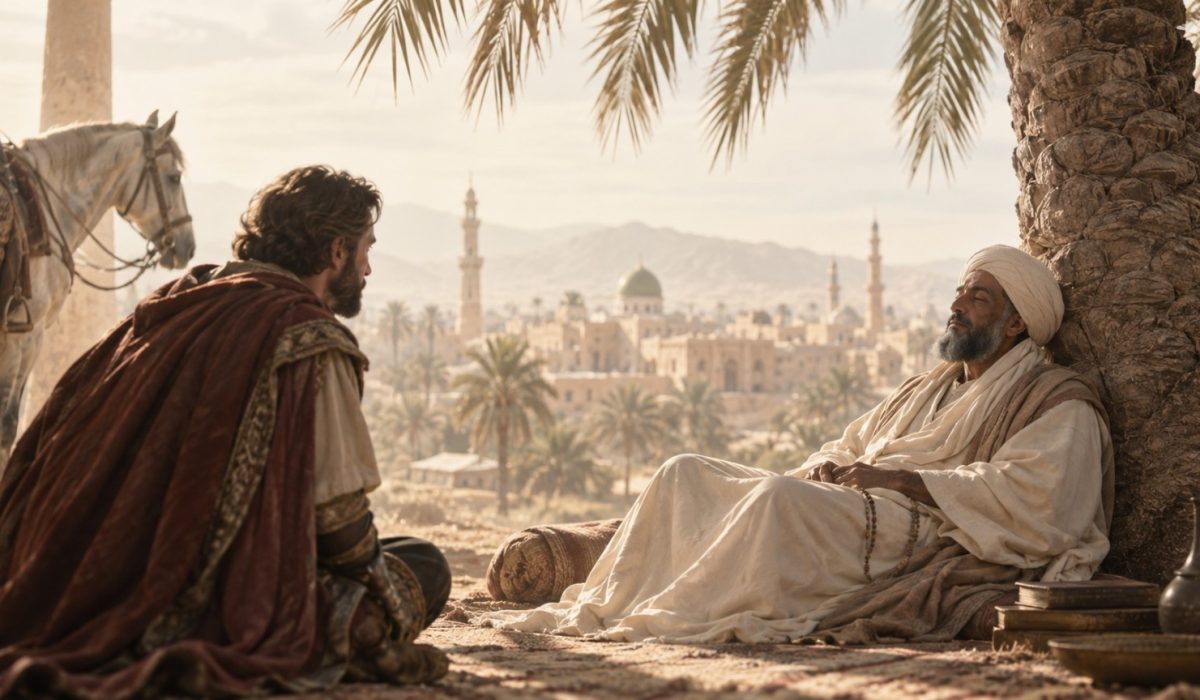
    A woman finally takes pity on him and reveals that the Caliph sleeps alone in the shade of a date palm:

    زیر خرمابن، ز خلقان او جدا زیر سایه خفته، بین سایهی خدا

    Beneath the date palm, separated from the people, sleeping in shade—see the shade of God.

    The Majesty Unveiled

    When the envoy sees the Caliph, something overwhelms him entirely:

    هیبتی ز آن خفته آمد بر رسول حالتی خوش کرد در جانش نزول

    A majesty from that sleeping one came upon the messenger, a sweet state made descent into his soul.

    The Caliph wears no jewels, no royal garments, no external symbols of power. He lies simply upon the ground. Yet this simplicity makes his majesty undeniable. What the envoy encounters is not the product of external grandeur, but something sacred itself.

    The text emphasizes a paradox at the heart of spiritual reality:

    مهر و هیبت هست ضد همدگر این دو ضد را دید، جمع اندر جگر

    Affection and majesty are opposites of one another—he saw these two opposites united in his heart.

    The envoy experiences both the warmth of love and terrifying awe at once—emotions that seem to contradict each other, yet are somehow present together. True greatness is not the coldness of distant power. It is the presence of something sacred that simultaneously attracts and overwhelms. Majesty does not come from external markers. It comes from God.

    The Pedagogy of Presence

    When the Caliph awakens and receives the envoy, he does not lecture from an elevated position. Instead, he speaks directly about the attributes of God and the intimacy of divine love. The Caliph’s teaching is not abstract but immediate. He has already begun to transform the envoy simply by being present to him.

    The Caliph explains something central to Rumi’s entire vision: just as only a bridegroom truly encounters the bride in intimacy and solitude, so too the lovers of God encounter the divine in a way inaccessible to others. Most people know of God intellectually; the true lover knows God through direct presence. This is not merely information passing from one mind to another. It is a transformation that occurs through proximity itself.

    The envoy asks how the immaterial soul could be confined in the body. The Caliph’s answer operates on multiple levels:

    گفت با جسم، آیتی تا جان شد او گفت با خورشید، تا رخشان شد او

    He said: “With the body, a sign such that the soul became. With the sun, such that it became radiant.”

    All things, through God’s command, move from non-being toward form. The earth becomes the dwelling place of the subtle spirit. This is not imprisonment. This is wedding. The spirit does not lose its nature by entering the body; the body becomes radiant through the presence of the spirit.

    This understanding is clarified through another image:

    آب صافی، در گلی پنهان شده جان صافی، بستهی ابدان شده

    Pure water hidden in clay; the pure soul bound by the body’s frame.

    Water does not cease to be water because it is contained in clay. The soul does not cease to be soul because it inhabits a body. What matters is what is essential and remains pure within the form.

    Yet the envoy presses further: if everything happens through God’s command, where is human choice? The Caliph’s response is subtle:

    اختیار و جبر ایشان دیگرست قطرهها اندر صدفها، گوهرست

    Free will and compulsion for them are other. Drops in shells become pearls.

    There is compulsion from external force, which denies freedom. But there is another compulsion entirely—the compulsion of love. When overwhelmed by love, you move toward it not through external force but through inner magnetism. You are compelled, yet not against your will. The lovers of God move in the sea of divine love like drops in an oyster that become pearls.

    The Caliph offers an everyday analogy:

    نان چو در سفرهست، باشد آن جماد در تن مردم شود او روح شاد

    As long as bread is on the table, it is merely a dead thing. In the body of humans it becomes a joyful spirit.

    Bread lies inert on the plate. Once eaten, it transforms into life itself. The soul, similarly, does not diminish by entering the body. It transforms the body.

    The Majesty of the Divine

    Throughout the story, Rumi returns to the theme of majesty—the overwhelming presence that cannot be explained through ordinary means. When the envoy encounters the Caliph, he feels this majesty so intensely that it frightens him. But this fear is not ordinary fear. It is awe—a trembling in the presence of something greater than oneself.

    The interpretation clarifies that the majesty of the great is from God, not from creation. It is not artificially produced. It comes from the presence of something sacred. Those who truly fear God—who hold the Divine in profound reverence—will not fear anything else. Their trembling is reserved for the Sacred alone. Once one has encountered majesty itself, everything else loses the power to intimidate.

    هر که ترسد، مر ورا ایمن کنند مر، دل ترسنده را ساکن کنند

    Whoever fears Him, may He make that one secure. May He make the fearful heart calm.

    This is the paradoxical gift of genuine spirituality: the person who is most afraid of God becomes the most fearless in the world, because fear has been concentrated entirely in its proper place. All other fears dissolve in the face of this primal awe.

    The Eye That Sees

    Rumi frames his entire story around a single crucial idea:

    آدمی دید است و باقی پوست است دید، آن است آن، که دید دوست است

    چونکه دید دوست نبود، کور به دوست، کو باقی نباشد، دور به

    The human is sight; the rest is merely skin. See, that which is sight, that is the seat where sight dwells.

    When sight does not see the Friend, it is blind to the Friend—where what remains is gone.

    The capacity to perceive is not incidental to human existence. It is the very essence of what it means to be human. But our sight has become obscured by our own attachments and preoccupations. We are captive to our wants and aversions, our identification with things that are not ourselves. These attachments function like clouds covering the sun. The sun has not disappeared; our capacity to perceive it has been diminished.

    For sight to truly perceive, one must empty the interior of everything other than love for the Beloved. Our attachments and scatterings are what prevent our true sight from opening. As long as we are bound to other things, we are blind to what is truly real.

    The Dissolution of Self

    As the conversation between the Caliph and the envoy deepens, something begins to happen to the envoy’s being. He is no longer thinking of himself as an official envoy with a message. He is becoming absorbed in something far larger than himself.

    The Roman envoy becomes so absorbed in the conversation that he forgets entirely why he came:

    آن رسول خود بشد زین یک دو جام نی رسالت یاد ماندنش نه پیام

    That messenger from that one or two cups became, neither the mission was remembered nor the message.

    This forgetting is not confusion. It is transformation. He came as an envoy from Rome; he is becoming something else entirely. Like water that flows into the ocean and ceases to be a stream, the envoy ceases to be a separate entity and becomes absorbed into something vastly larger.

    The interpretation expresses this in stark terms:

    ای خنک آن مرد کز خود رسته شد در وجود زندهی پاینده شد

    Blessed is the person who escaped from themselves and entered into eternal existence.

    But there is a terrible corollary:

    وای آن زنده که با مرده، نشست مرده گشت و زندگی از وی بجست

    Woe to that living one who sat beside the dead; he became dead and life fled from him.

    To sit near an enlightened being while remaining identified with your own separate existence is to remain dead even while appearing alive. Without transformation, without the willingness to die to oneself, one becomes even more dead by contrast.

    The Nothingness That Is Everything

    Rumi suggests that human beings are like the letter aleph—a single line that has no inherent meaning by itself. Everything we think of as “ourselves” is actually nothing but form. Everything we possess is borrowed.

    ما کیایم اندر جهان پیچ پیچ؟ چون الف، او خود چه دارد؟ هیچ هیچ

    What are we in this twisted world? Like the aleph—what does it itself have? Nothing, nothing.

    This is not nihilism. It is liberation. If we recognize that we are nothing—that everything in us is borrowed and temporary—then we are free. We stop trying to preserve a self that was never solid to begin with. But this emptiness is not the end. It is the beginning. For when we accept our nothingness, we become capable of being filled with something real.

    Knowledge and Ignorance

    The interpretation adds another dimension:

    گر به جهل آییم، آن زندان اوست ور به علم آییم، آن ایوان اوست

    ور به خواب آییم، مستان وییم ور به بیداری، به دستان وییم

    If we come in ignorance, it is His prison. If we come in knowledge, it is His palace.

    If we come in sleep, we are drunk. If we come in wakefulness, we are in His hands.

    Everything depends on the state we bring to the encounter. If we approach God in ignorance, we are in prison, trapped in illusion. But if we have cultivated knowledge—if we have awakened to the truth about ourselves and the world—then the same reality becomes a palace, a place of beauty and freedom.

    The Question That Remains

    The story asks its Western readers a direct question, though it nowhere states it explicitly: What if the greatness you seek is not found where you have been looking? What if it requires a purification of your perception? What if the palace you search for can only be seen by an eye that has learned to look inward? And what if sitting in the presence of one who has seen clearly enough—who has become transparent enough to the Divine—could transform you completely, if you were willing to forget yourself entirely?

    These are not comfortable questions. They do not permit the comfortable distance that much modern spirituality allows—the idea that we can acquire wisdom while remaining fundamentally unchanged, that we can learn truths while preserving our old selves intact. Rumi insists otherwise. The transformation is total or it is nothing at all.

    The envoy’s mission from Rome is forgotten. His identity as an official representative is forgotten. Everything that defined him in the eyes of the world is forgotten. In its place, he discovers something so real, so overwhelming, so undeniable that by comparison, everything he was before appears as shadow and dust.

    The palace of the heart is not a metaphor for internal psychology or self-help wisdom. It is a challenge to the very foundation of how we perceive reality. It demands a radical reorientation of what we consider real, valuable, and worth seeking. The envoy did not acquire this understanding through study or intellectual effort. He acquired it through desperation, through humility, through the willingness to be utterly confused and lost, and finally through the grace of presence—the presence of one who had already made this journey.

    This is what it means to see truly. This is what it means to find the palace of the heart.

    Source

    Rumi, The Masnavi, Book One (Daftar-i Avval), verses 1390–1546, the eleventh story: “The Tale of the Envoy from Rome Coming to the Caliph” (Hekayat-i Aamadan-i Rasool-i Room).

  • Rumi’s Parrot and the Illusion of False Analogy | Masnavi

    Rumi’s Parrot and the Illusion of False Analogy | Masnavi

    Human perception suffers from a persistent, primordial ailment. We gaze upon the surface of reality and presume to have understood its depths. We measure the infinite through the narrow lens of the finite, mistaking outward similarity for essential identity. This cognitive and spiritual trap—known in mystical traditions as false analogy or qiyas—forms one of the most perilous obstacles on the path toward divine realization. When the unawakened mind encounters spiritual perfection, it instinctively reduces that perfection to its own mundane level, judging the holy through the flawed categories of the conditioned self.

    Form deceives. Shadows mimic substance. In the foundational book of the Masnavi-i Ma’navi, Jalal al-Din Rumi unveils this universal existential struggle through a deceptively simple narrative: the tale of a grocer and his articulate green parrot. Beneath the atmospheric charm of an oriental bazaar lies a profound commentary on the human tendency to project personal limitations onto the divine. The parable serves as a timeless mirror. It forces us to confront our own spiritual blindness, challenging the comfortable assumptions by which we categorize the sacred and the profane.

    To misunderstand the nature of spiritual reality is not merely an intellectual error; it is an existential exile. When we evaluate the quietude of a saint through the lens of our own spiritual lethargy, or when we mistake outward affliction for divine abandonment, we remain imprisoned within the house of ego. Rumi’s masterpiece invites us to shatter these superficial categories, guiding the soul away from the tyranny of appearances toward the uncreated light of pure essence.

    Cinematic Retelling of the Parable: Silence in the Bazaar

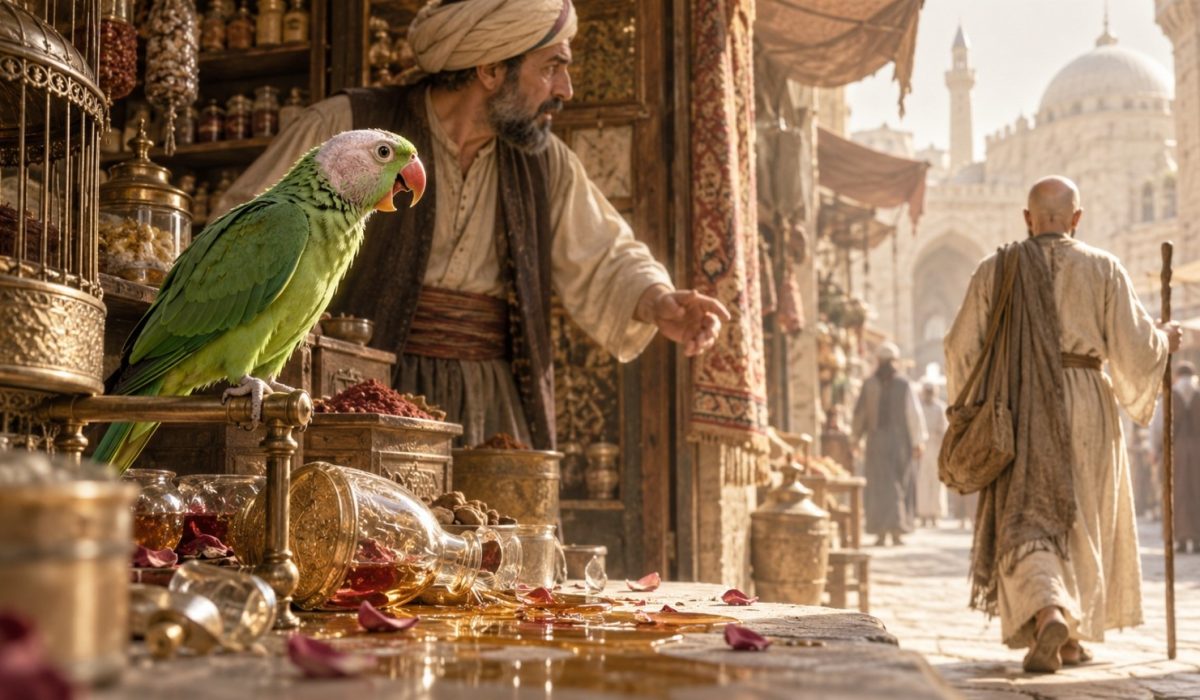
    Once, in a bustling town, there lived a grocer who kept a green parrot within his shop. The bird was extraordinary—sweet-voiced, eloquent, and vigilant. It served not only as a watchful guardian of the store while its master was away, but also as a delightful companion to the patrons, entertaining them with graceful phrases and witty sayings.

    بود بقالی و وی را طوطیی
    خوشنوایی، سبز گویا طوطیی
    جست از سوی دکان، سویی گریخت
    شیشههای روغن گل را بریخت

    There was a grocer who possessed a parrot—a sweet-voiced, green, speaking parrot. One day, startled, it fluttered from one side of the shop to the other, overturning and spilling the glass bottles of precious rose oil.

    The amber elixir pooled across the wooden floor. Fragrance filled the air, thick and mournful. When the merchant returned and discovered the ruined flasks, fury ignited within his chest. Blinded by sudden rage, he struck the parrot violently upon its head. The blow was harsh. Under the impact of the strike, the parrot lost all the delicate feathers upon its head, becoming entirely bald. More tragically, its melodious voice withered away into absolute silence.

    Days turned into a heavy, suffocating silence. The bird sat perched in its cage, mute, brooding, and featherless. The grocer’s anger melted into profound remorse. He wept. He offered alms to the poor. He tried every artifice to entice his companion back into speech, but the bird remained motionless, trapped in its quiet grief.

    دست من بشکسته بودی آن زمان
    چون زدم من بر سر آن خوشزبان

    “Would that my hand had been broken at that moment,” the grocer lamented, “when I struck the head of that sweet-tongued bird!”

    Despair settled over the shop. Then, on a fateful morning, a wandering dervish passed through the alleyway. The dervish’s head was completely bare, devoid of hair, smooth as a polished stone. The moment the parrot cast its eyes upon the bald traveler, its long silence shattered. It raised its voice and shouted across the street with immediate, earnest conviction.

    طوطی اندر گفت آمد در زمان
    بانگ بر درویش زد که: هی فلان
    از چه ای کل با کالن آمیختی؟
    تو مگر از شیشه روغن ریختی؟

    Instantly, the parrot broke into speech, calling out to the dervish: “Hey, fellow! How did you come to mix with the bald ones? Did you also spill the bottles of rose oil?”

    The onlookers laughed at the bird’s naive deduction. Yet, this simple moment contained a devastating revelation. The parrot had projected its own history, its own trauma, and its own physical cause onto an entire stranger whose baldness arose from an entirely different realm of spiritual discipline and renunciation. It saw its own reflection in the world and mistook it for objective reality.

    Exegesis of the Symbol: The Internal Wisdom of the Motifs

    Rumi uses this comical misinterpretation as a springboard into profound spiritual exegesis. The parrot represents the conditioned mind—the egoic apparatus that relies on repetition, imitation, and sensory surface observations. It can speak, but its speech is merely a reflection of what it has heard. It lacks direct spiritual insight (ma’rifat). When confronted with a reality that resembles its own external appearance, it immediately assumes an identity of essence.

    کار پاکان را قیاس از خود مگیر
    گرچه ماند در نبشتن شیر و شیر
    جمله عالم زین سبب گمراه شد
    کم کسی از ابدال حق آگاه شد
    همسری با اولیا برداشتند
    اولیا را همچو خود پنداشتند

    Do not measure the actions of the pure by the scale of yourself, even though ‘shir’ (lion) and ‘shir’ (milk) are written identically in script. The entire world has gone astray because of this; few are those who are aware of God’s transformed servants (abdal). They claimed equality with the saints, imagining the saints to be just like themselves.

    Words deceive. In the Persian script, the word for milk (shir) and the word for lion (shir) appear identical, yet one is a nourishing liquid while the other is a fierce, life-taking predator. To judge solely by the written mark is to invite catastrophe. In the same way, the external actions of a spiritually awakened human being (wali or abdal) may outwardly resemble the actions of an ordinary, ego-bound person, yet their inner reality lies worlds apart.

    Consider the act of receiving sustenance. Two individuals may sit at the same table and consume the very same loaf of bread. Yet, the spiritual transmutation within them follows entirely opposite vectors.

    این خورد، گردد پلیدی زو جدا
    آن خورد، گردد همه نور خدا
    این خورد، زاید همه بخل و حسد
    آن خورد، زاید همه عشق احد

    This one eats, and from it arises impurity; that one eats, and it becomes entirely the Light of God. This one eats, and it spawns envy and avarice; that one eats, and it births the pure Love of the One.

    Intention transforms essence. The food ingested by a person enslaved to the mental self feeds wrath, pride, and petty possessiveness. Conversely, the very same nourishment consumed by a heart established in divine presence (huzur) is transmuted into illumination, compassion, and divine wisdom. The outward form of eating is identical; the inward yield is light versus darkness.

    This principle extends to patience and endurance. The worldly person bears suffering out of stubbornness, pride, or helpless resignation, nursing hidden resentment within. The spiritual master endures tribulations with profound serenity, viewing them as manifestations of divine grace. To call both states “patience” is a linguistic illusion. One is a prison; the other is absolute freedom.

    Existential Exile & The Memory of the Soul

    Why does humanity persistently fall into this error? Rumi points to the gravitational pull of spiritual affinity. Every soul is drawn toward its own kind, operating according to its true spiritual name rather than its worldly title.

    هر یکی سوی مقام خود رود
    هر یکی بر وفق نام خود رود

    Each moves toward its own station; each acts according to the harmony of its true name.

    A person may bear the outward label of a believer, yet if their inner condition is rooted in hypocrisy and self-deception, they will inevitably gravitate toward the hypocritical. The soul possesses an innate magnetics. It cannot be fooled by outer professions of faith or academic knowledge. It aligns strictly with its interior essence.

    This realization introduces a painful paradox in the spiritual journey: the necessity of interior destruction. The house of the false self—the conditioned mental ego—must fall into ruin before the true divine treasure can be uncovered.

    راه جان، مر جسم را ویران کند
    بعد از آن ویرانی، آبادان کند
    کرد ویران، خانه بهر گنج زر
    و ز همان گنجش کند معمورتر

    The path of the Spirit ruins the body, and after that devastation, brings it to true flourish. It demolishes the house to uncover the hidden treasure of gold, and with that very gold rebuilds a far grander palace.

    We fear the destruction of our established habits and mental comforts. We cling to the outer structure of our identity, unaware that beneath its floorboards lies a vast, unblemished spiritual wealth. The divine master breaks the clay vessel only to free the water of life within. The destruction is not an act of cruelty; it is the ultimate mercy. To reach true spiritual habitation, the desolate cottage of self-importance must be razed to the ground.

    The Unspoken Truth: Preservation of Inner Clarity

    In a world saturated with imitations, spiritual discernment becomes the ultimate inner sanctuary. Rumi warns sternly against the deceptive nature of false teachers who master the language of holiness without possessing its essence. They wear the garments of the wise, recite the words of the illuminated, and present themselves as guides, yet their internal origin is dark.

    چون بسی ابلیس آدمروی هست
    پس به هر دستی نشاید داد دست
    حرف درویشان بدزدد مرد دون
    تا بخواند بر سلیمی ز آن فسون

    Since there are many devils appearing in the form of Adam, it is not fitting to place one’s hand into every hand. The base man steals the vocabulary of dervishes to cast a spell over the innocent and pure-hearted.

    The charlatan steals the vocabulary of real seekers to weave a web of charm. They trade in hollow rhetoric, exploiting the soul’s deep longing for home. Just as a counterfeit coin mimics the glint of genuine gold, the spiritual pretender mimics the postures of liberation. But its ultimate fruit reveals its nature.

    آن شراب حق، ختامش مشکناب
    باده را ختمش بود گند و عذاب

    The pure wine of Truth culminates in the fragrance of pure musk; the intoxicating wine of illusion ends only in stench and torment.

    Truth needs no defense to those who possess spiritual taste (dhawq). The authentic presence of a realized soul acts as pure, unadulterated wine. It brings sober awareness, awakening the heart from its ancient slumbers. It does not bind; it liberates. It does not flatter the ego; it dissolves it. The wine of illusion, however, offers a fleeting high followed by spiritual exhaustion, leaving the seeker more alienated than before.

    Preserving inner clarity requires unyielding vigilance. One must look past the spoken phrase, past the charismatic demeanor, past the bald head of the dervish, and perceive the underlying essence. Does this path lead toward the dissolution of the ego, or does it merely serve to enlarge its subtle demands?

    Concluding Contemplation

    Silence falls over the bazaar once more. The grocer, the parrot, and the bald dervish fade into the tapestry of the parable, leaving behind a pristine mirror for the contemplative mind.

    We are all, in some measure, like the parrot in the shop. We sit in the cage of our sensory perceptions, evaluating the vast mysteries of existence through our small, personal injuries and triumphs. When we encounter the spiritual giants of humanity, our first instinct is to pull them down to our level—to assume that their silence is our silence, their poverty our poverty, their loss our loss.

    Look closer. The illusion shatters.

    True awakening demands the abandonment of false comparison. It requires us to step beyond the outward likeness of milk and lions, beyond the identical scripts of life, and enter the quiet sanctuary of the heart where spirit alone discerns spirit. Only when the house of the ego is shattered and the hidden treasure uncovered can the soul cease its naive babble and align with the timeless silence of the divine presence.

    Source

    Masnavi, Book One — Verses 247–323 — The Second Tale

  • Rumi and the Sickness of the Heart: The King, the Handmaiden, and the Divine Physician

    Rumi and the Sickness of the Heart: The King, the Handmaiden, and the Divine Physician

    The timeless allegories of the Sufi traditions do not exist to entertain the temporal mind. They are precision instruments designed to dissect the unseen anatomy of human suffering. In the opening movement of the Mathnawi, Jalal al-Din Rumi unveils a parable that functions not merely as an ancient tale, but as an immediate mirror held up to the human spirit in its state of earthly exile. It is an invitation to witness our own hidden turmoil, our misdirected longings, and the quiet mechanics of divine mercy operating beneath the veil of grief.

    Before the narrative unfolds its delicate layers, the text establishes its universal mirror. It speaks directly to the inward state of every traveler trapped within the dualities of existence:

    بشنوید ای دوستان این داستان
    خود حقیقت نقد حال ماست آن

    “Listen, O friends, to this tale, for in truth, it is the immediate condition of our own present state.”

    The soul remembers. We wander through existence carrying an unnamable nostalgia. The parable begins with a sovereign—a king possessed of boundless earthly power and treasury—who rides out into the wilderness on a hunt. Yet this monarch, despite his absolute outward independence from worldly needs, encounters a humble handmaiden upon the highway. In an instant, his royal sovereignty dissolves into total captivity. He becomes a slave to her love. This paradoxical encounter forms the foundation of our spiritual predicament: the regal, pristine spirit descending into the realm of form, binding its eternal affection to that which is frail, mortal, and subject to decay.

    Cinematic Retelling of the Parable: The Court, The Couch, and The Quiet Call

    The king brings the maiden to his court. He surrounds her with imperial majesty. Yet no sooner does she enter his palace than a catastrophic sickness overtakes her. Her body languishes. Her complexion pales. Her vitality ebbs away like water slipping through parched fingers.

    یک کنیزک دید شه، بر شاهراه
    شد غلام آن کنیزک، جان شاه

    “A handmaiden the king beheld upon the highway; the king’s very soul became a thrall to that maiden.”

    Grief besieges the sovereign. He summons the most revered physicians of the realm—men steeped in mechanical medicine, intellectual hubris, and worldly prestige. He promises them boundless treasures, declaring that her life is his life, her health his sole breath. Confident in their learned formulas, the physicians boast of their ability to restore her. Yet, in their spiritual blindness and intellectual pride, they fail to utter the sacred qualification: Inshallah—God willing.

    «گر خدا خواهد» نگفتند از بطر
    پس خدا بنمودشان عجز بشر
    از قضا سرکنگبین، صفرا نمود
    روغن بادام خشکی می‌افزود

    “Out of pride, they neglected to say ‘If God wills’; therefore God made manifest to them the utter powerlessness of man. By decree, oxymel increased the bile, and almond oil only added to the dryness.”

    Every remedy applied by the arrogant physicians produces its exact opposite effect. Syrups turn to poison. Soothing oils inflame the fever. Darkness deepens. The maiden slips closer to the abyss. Seeing the total impotence of human intellect reliant upon imitative lore, the king cast off his royal arrogance. He turns away from human means. He runs to the sanctuary, casting his face upon the dust, weeping tears of absolute helplessness until his conscious mind fades into a swoon.

    Faith rises from despair. In the depth of his surrender, a vision awakens. An ethereal physician appears within his inner horizon—a divine sage whose outer posture is bent and slender, yet whose heart carries the direct light of Providence. The sage enters the royal court without pomp. The king recognizes him instantly, not through sensory proof, but through the instinct of the soul.

    از خدا جوییم توفیق ادب
    بی‌ادب محروم گشت از لطف حق
    هر چه بر تو آید از ظلمات و غم
    آن ز بی‌باکی و گستاخی است هم

    “Let us seek from God the grace of proper spiritual courtesy; for he who lacks courtesy is deprived of the Lord’s grace. Whatever darkness or sorrow befalls you springs entirely from insolence and presumption.”

    Exegesis of the Symbol: The Internal Wisdom of the Motifs

    To understand this parable is to map the inner landscape of human consciousness. Rumi constructs a profound psychospiritual architecture where every character represents an aspect of the internal self:

    • The King (پادشاه): Represents the pure Spirit, the transcendent soul, or the radiant consciousness within man. He is natively majestic, wealthy, and unfettered, yet bound by divine decree to journey through the lower worlds.
    • The Handmaiden (کنیزک): Symbolizes the psycho-somatic vehicle—the mind and the physical form. She is delicate, vulnerable to worldly conditioning, and prone to spiritual sickness when severed from her true spiritual source.
    • The Earthly Physicians (طبیبان مدعی): Represent the egoistic, imitative intellect. They are the accumulated mental constructs, theories, and dead traditions that attempt to cure the soul’s existential dread using physical, surface-level remedies. They treat symptoms while missing the root cause.
    • The Divine Physician (حکیم الهی): Symbolizes Primordial Wisdom, the Living Master, or divine grace acting within the depths of silent awareness. He operates beyond superficial diagnosis, discerning the hidden secrets of the heart.
    • The Goldsmith of Samarkand (زرگر سمرقندی): Represents the transient beauty of the physical world—the perishable objects of desire, sensory allure, and outward appearances that capture the mind’s affection and drag it into spiritual decay.

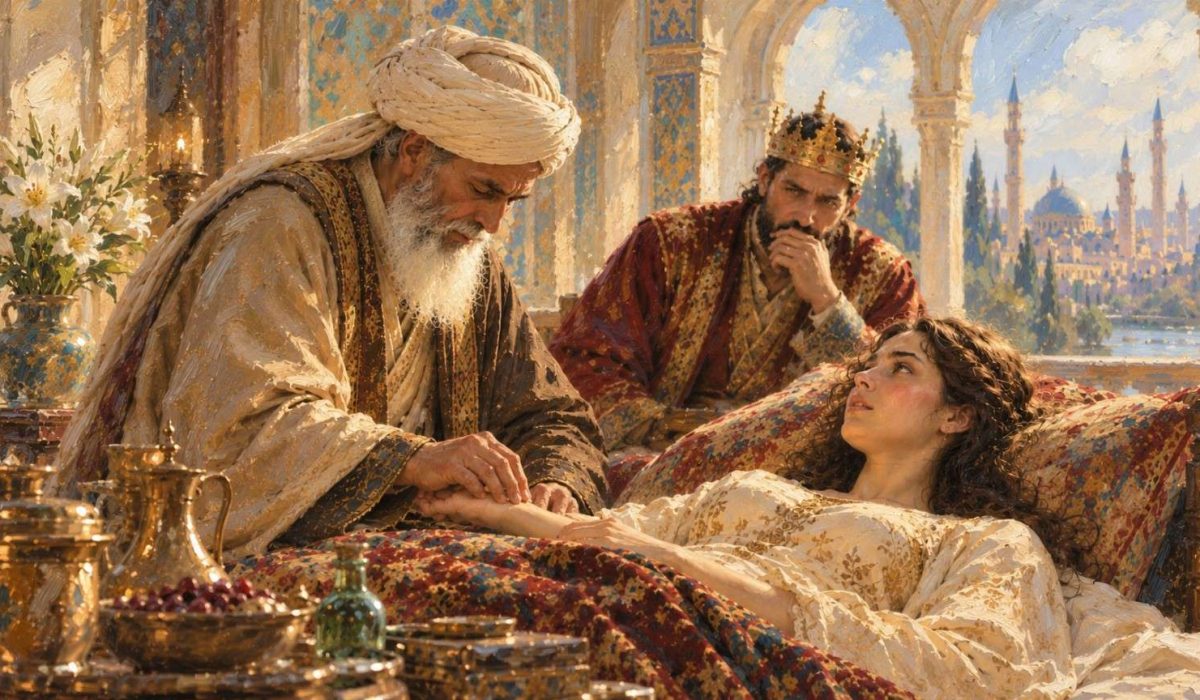
    The divine physician clears the chamber. He requests that all onlookers, intimates, and servants leave the room. Truth demands total intimacy. Solitude falls. The divine sage sits beside the ailing maiden, softly placing his fingers upon her pulse. He does not ask about humors, bile, or physical ailments. Instead, he begins to gently speak of distant cities, of roads traveled, of friends and places known.

    He listens not merely to her words, but to the rhythm of her heartbeat. He mentions Damascus. The pulse remains steady. He mentions Mosul. Nothing changes. He mentions Samarkand—and suddenly, her pulse leaps. Her cheeks flush with hidden fire. Her breath catches. The root of her affliction stands revealed: her heart is secretly tethered to a young goldsmith in the city of Samarkand.

    عاشقی پیداست از زاری دل
    نیست بیماری، چو بیماری دل
    علت عاشق ز علتها جداست
    عشق، اسطرلاب اسرار خداست
    عاشقی گر زین سر و گر زان سر است
    عاقبت ما را بدان سر رهبر است
    آفتاب آمد دلیل آفتاب
    گر دلیلت باید، از وی روی متاب

    “Love’s affliction is made plain through the lamenting heart; there is no sickness like the sickness of the heart. The lover’s ailment is separate from all other ills; love is the astrolabe of God’s mysteries. Whether love be from this earthly side or that transcendent realm, in the end it leads us toward that supreme Sovereign. The sun itself is the proof of the sun; if you require proof, turn not your face away from it!”

    Existential Exile & The Memory of the Soul

    Why does the handmaiden fall ill? She sickens because her heart is divided. She resides in the King’s palace, surrounded by spiritual nobility, yet her inner longing is held captive by an earthly form in Samarkand. This is the precise definition of existential exile (الغربة الوجودية). The human mind, housed within the magnificent palace of spiritual existence, remains tormented as long as it seeks its ultimate fulfillment in the fleeting glitter of created things.

    The Goldsmith is the master of superficial ornament. He takes raw metal and crafts temporary beauty upon its surface. So too does the world gild perishable forms, luring the heart into false worship. The mind falls in love with the gilded vessel, unaware that the beauty it admires is merely a borrowed reflection of the Divine Sun.

    The divine physician acts with absolute, uncompromising mercy. He does not preach to the maiden. He does not scold her conditioned attachments. Instead, he orders the king to send messengers to Samarkand, bearing lavish gifts of gold and royal garments to entice the goldsmith to court. The goldsmith, blinded by pride and avarice, accepts the summons. He leaves his home with immense joy, walking willingly into the trap of his own destiny.

    ای شده اندر سفر با صد رضا
    خود به پای خویش تا سوالقضا

    “O you who set forth upon the journey with hundredfold delight, walking with your own feet toward the very brink of destiny!”

    The goldsmith arrives at the palace. He is wedded to the handmaiden by royal decree. For six months, the maiden drinks from the cup of earthly union. Her health returns. Her cheeks regain their bloom. The king observes quietly, allowing the illusion to run its natural course under the watchful guidance of the divine sage.

    Then, the divine physician prepares a potion. Day by day, he administers a subtle potion to the goldsmith. The goldsmith begins to wither. His radiant beauty vanishes. His complexion turns sickly and pale. His vibrant form becomes repulsive and unsightly. As his physical charm dissolves, the handmaiden’s affection turns to disgust. The love that was built entirely upon form, color, and sensory appeal vanishes alongside the decay of that form.

    عشق‌هایی کز پی رنگی بود
    عشق نبود، عاقبت ننگی بود

    “Those loves that are rooted in mere color and outer form are not love at all; in the end, they prove to be a shameful disgrace.”

    The Unspoken Truth: Preservation of Inner Clarity

    Here, the parable confronts the seeker with an enigmatic moral paradox. Why must the goldsmith suffer? Why must the divine physician administer the potion that leads to his demise? The text anticipates the hesitation of the superficial mind. It clarifies that the actions of the divine physician are not driven by human malice, personal desire, or arbitrary cruelty. They are guided entirely by transcendent divine decree.

    The death of the goldsmith represents the inevitable dissolution of worldly illusion. The divine sage does not commit a crime; he acts as the agent of ultimate reality, breaking the false idol so that the soul may be liberated from its self-imposed prison. Just as time inevitably strips beauty from the physical form, the divine intervention strips away the illusion of permanence from that which is fundamentally transient. It is an act of spiritual liberation—the truth requires no defense before those who remain incapable of perceiving its depth.

    When the goldsmith perishes, the handmaiden’s vision is finally purged of secondary causes. She sees the emptiness of her former attachment. Her heart, cleansed of its idolatrous affection for perishable form, turns naturally and entirely toward the eternal King. Her healing is no longer temporary; it is complete, permanent, and transcendent.

    عشق آن بگزین که جمله انبیا
    یافتند از عشق او کار و کیا
    تو مگو ما را بدان شه، بار نیست
    با کریمان کارها دشوار نیست

    “Choose that love from which all the prophets derived their supreme power and majesty. Do not say, ‘To that Sovereign I have no access’; for in dealing with the truly generous, no task remains difficult.”

    The sacrifice of the lower, finite attachment is the precise mechanism by which infinite spiritual life is realized. The narrative captures this divine exchange in a verse of profound serenity:

    نیم جان بستاند و صد جان دهد
    آنکه در وهمت نیاید، آن دهد

    “He takes away a half-life and bestows a hundred true lives; He grants that which lies far beyond the reach of your imagination.”

    Concluding Contemplation

    Silence falls upon the chamber of the heart. The journey from the highway to the court, from the sickness of divided desires to the total clarity of divine union, requires the quiet collapse of our intellectual self-sufficiency. We are, all at once, the distressed King longing for spirit, the ailing Handmaiden trapped in worldly affection, the arrogant physicians relying on empty formulas, and the Divine Sage listening quietly in the dark to the erratic pulse of our hidden longings.

    The pain we experience in the presence of decaying form is not punishment. It is grace. It is the steady hand of the divine physician severing the ropes that bind us to impermanence. When the false gilding fades and the goldsmith of form perishes from our consciousness, the soul ceases its wandering. The mirror of the heart is wiped clean of ancient dust. In that stillness, the Eternal King remains, requiring no proof, no argument, and no defense—only the total surrender of a heart restored to its original, unblemished light.

    Source

    The Masnavi Manavi, Book I, verses 35–246.

  • Rumi’s Tree of Life: The Masnavi Tale of Knowledge and Immortality

    Rumi’s Tree of Life: The Masnavi Tale of Knowledge and Immortality

    We spend our lives searching. We search for happiness in a new job, in a better relationship, in a bigger house, in a distant city. We travel, we read, we ask, we hope. And still, we often feel empty. Still, we feel like something is missing.

    This is not a new feeling. Eight hundred years ago, the Persian poet Jalal al-Din Rumi told a story about this very search. It is a story about a king who heard of a tree whose fruit grants eternal life. It is a story about a messenger who traveled to the ends of the earth to find it. And it is a story about a wise man who laughed and said: you have been looking in the wrong direction.

    The tale is found in the second book of Rumi’s Masnavi, verses 3641 to 3680. It is the sixty-second tale. And it speaks to something deep within all of us.

    A wise man once told a story.

    گفت دانایی برای داستان / که درختی هست در هندوستان

    A wise man said in a story: “There is a tree in India.”

    هر کسی کز میوه ی او خورد و برد / نه شود او پیر، نه هرگز بمر

    Whoever eats from its fruit shall never grow old, nor ever die.

    A tree whose fruit gives immortality. No aging, no sickness, no death. Just endless life. The king heard this and could not forget it.

    پادشاهی این شنید از صادقی / بر درخت و میوه اش شد عاشقی

    A king heard this from a truthful man, and fell in love with the tree and its fruit.

    The king was not content to just hear the story. He had to find the tree. He had to taste the fruit. So he sent a messenger to India.

    پادشاهی این شنید از صادقی / بر درخت و میوه اش شد عاشقی

    The king sent a messenger to India to search for that tree.

    The messenger traveled far and wide. He crossed deserts and mountains. He asked every scholar and sage he met. He searched for years. But everyone he asked laughed at him.

    هر که را پرسید، کردش ریشخند / کین که جوید جز مگر مجنون بد؟

    Everyone he asked mocked him, saying: “Who seeks this except a madman?”

    He was called crazy. He was called foolish. People told him he was wasting his life chasing a myth. But he kept searching. Years passed. His hope began to fade.

    هیچ از مقصود، اثر پیدا نشد / ز آن غرض غیر خبر پیدا نشد

    No trace of the goal was found, and nothing was obtained from that quest except rumors.

    رشته ی امید او بگسسته شد / جسته ی او عاقبت ناجسته شد

    The thread of his hope was cut, and what he sought remained unfound.

    He had failed. The tree was nowhere to be found. He gave up and started the long journey home. On his way back, he passed by the dwelling of a sheikh. This was no ordinary man. He was a scholar, a spiritual master, a man of deep wisdom.

    بود شیخی، عالمی، قطبی کریم / اندر آن منزل که آیس شد ندیم

    In that dwelling was a sheikh, a scholar, a generous spiritual master.

    The messenger, broken and hopeless, went to the sheikh and told him his story.

    گفت: من نومید پیش او روم / ز آستان او به راه اندر شوم

    He said: “I will go to him in despair, and from his threshold I will enter the path.”

    He explained everything. The king’s command. The long journey. The mockery. The years of searching. The bitter disappointment. He had nothing left to show for his efforts.

    The sheikh listened. And then he laughed.

    شیخ خندید و بگفتش: ای سلیم / این درخت علم باشد در علیم

    The sheikh laughed and said: “O simple one! This tree is knowledge, found within the learned.”

    The tree was never in India. It was never made of wood. It was never something you could touch or taste. The tree is knowledge. Not the kind of knowledge you find in books. The kind of knowledge that transforms who you are. The kind of knowledge that makes you see clearly.

    The sheikh continued.

    بس بلند و بس شگرف و بس بسیط / آب حیوانی ز دریای محیط

    Very high, very wondrous, and very simple. It is the water of life from the surrounding ocean.

    This tree is not small or ordinary. It is vast and deep. It is the source of life itself. It flows from the ocean of divine truth. Its branches reach high. Its roots go deep. And it is within you.

    تو به صورت رفته ای گمگشته یی / زآن نم یی ابی که معنی هشته یی

    You have gone to the outer form and become lost, because you neglected the inner meaning.

    The messenger had been looking at the surface. He had been looking for a physical tree in a physical place. He had forgotten to look within. He had forgotten to look at the meaning behind the story.

    The sheikh explained that the truth appears in many forms.

    که درختش نام شد، گاه آفتاب / گاه بحرش نام شد، گاهی سحاب

    Sometimes it is called a tree, sometimes the sun, sometimes the sea, sometimes the cloud.

    The names change, but the essence is one. Whether we call it a tree, a sun, a sea, or a cloud, we are pointing to the same truth. The truth that is beyond all names. The truth that cannot be captured by any one word.

    Rumi then adds this reflection.

    هر که جويد نام گر صاحبثقه است / تا صفا ت ره نمايد سوي ذات

    Whoever seeks the name, if they are trustworthy, will reach the purity that leads to the essence.

    The name can be a guide. But it is not the destination. It is like a signpost pointing to the road. If you stop at the signpost, you will never reach your destination.

    در گذر از نام و بنگر در صفات / چون به معنی رفت، آرام اوفتاد

    Pass beyond the name and look at the qualities. When you reach the meaning, disturbance subsides.

    When you move beyond names, you find peace. When you stop arguing about what things are called, you find rest. This is why there is so much conflict in the world.

    اختالف خلق از نام اوفتاد

    The disagreement of people arises from names.

    Muslim, Christian, Jew, Hindu. These are names. They are not the essence. The essence is one. When we forget this, we fight. When we remember this, we find peace.

    Now we must ask ourselves: what does this tree mean for us? What does it mean for our daily lives?

    The tree is knowledge. But not the kind of knowledge you can memorize. Not the kind you can find on Wikipedia or in a library. It is the knowledge of yourself. The knowledge of what is true and what is false in your own heart.

    It is the knowledge that helps you see your own anger before it explodes. It is the knowledge that helps you see your own fear before it controls you. It is the knowledge that helps you see your own ego before it destroys your relationships.

    The fruit of this tree is wisdom. It is the ability to pause before you speak. It is the ability to choose kindness over revenge. It is the ability to let go of things that do not matter.

    Every time you choose understanding over anger, you eat from this fruit. Every time you choose silence over hurtful words, you drink from this water. Every time you recognize your own mistakes and apologize, you taste the sweetness of this tree.

    This is what immortality means. Not living forever in the body. But living so fully in the present that time loses its power over you. No longer being trapped by the past. No longer being afraid of the future. Being completely alive in this moment.

    The messenger searched for years. He traveled thousands of miles. He endured mockery and disappointment. And in the end, the answer was not in India. It was not in a tree. It was not in a fruit. The answer was in a word from a wise man: knowledge. The answer was in the recognition that he had been looking outside for something that was inside all along.

    We are all that messenger. We are all searching. We are all traveling through our own India. Through our careers, relationships, achievements, and possessions. And we are all, eventually, finding that none of it gives us what we truly want.

    But the sheikh is still there. The wise voice is still there. And it is saying the same thing it said eight hundred years ago.

    Stop searching out there. The tree is here. The fruit is here. It is knowledge. It is wisdom. It is the recognition of who you really are.

    The tree that bears the fruit of life is not a tree. It is you. When you wake up to that truth, you taste the fruit of immortality. And once you taste it, you never forget its sweetness.


    Source: Masnavi-e-Ma’navi, Book Two – Verses 3641 to 3680 – The Sixty-Second Tale

    Rumi quotes

  • Rumi on Patience and the Armor of David: A Tale from the Masnavi

    Rumi on Patience and the Armor of David: A Tale from the Masnavi

    In our hyper-connected, lightning-fast world, patience has become an endangered species. We refresh our inboxes obsessively. We grow tense at red lights. We demand instant answers to every question that flickers through our minds. We are conditioned to believe that speed equals efficiency, and that asking “Why?” right now is the only way forward.

    But what if the greatest shortcut to understanding is actually not asking? What if the most potent action we can take in moments of confusion is a deliberate, conscious pause—a silence that speaks louder than any question?

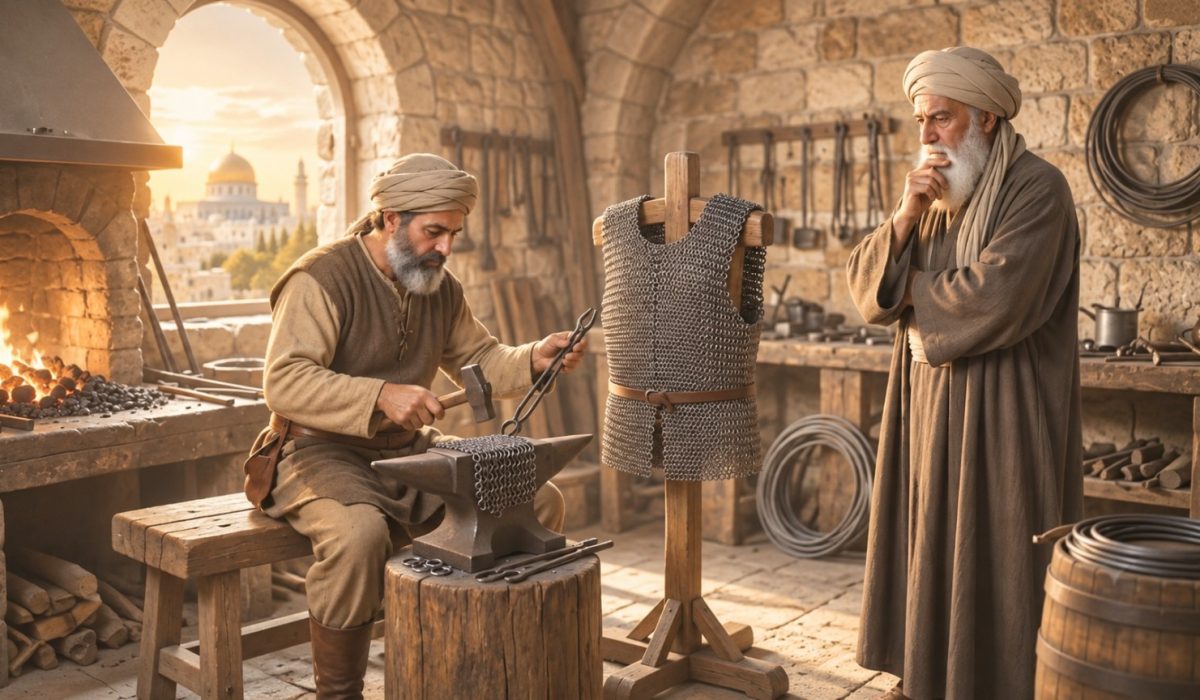
    This is the radical, counterintuitive proposition at the heart of a remarkable 13th-century story from Jalal al-Din Rumi’s Masnavi-e-Ma’navi. It features Luqman the Wise, a figure renowned for his profound insight, who visits Prophet David and watches him forge iron rings into an unrecognizable, tangled mesh. Every fiber of Luqman’s being urges him to ask, “What on earth are you making?” Yet, against all modern logic, he chooses silence. He resists the itch to interrupt the process.

    What unfolds is not just a lesson in waiting; it is a masterclass in psychological resilience, emotional intelligence, and the subtle art of self-mastery. Rumi takes us deeper, revealing the crucial—and often misunderstood—difference between mere tolerance (silence born of fear) and genuine patience (silence born of awareness).

    In a time when our attention is fractured and our nerves are frayed, this ancient tale offers a desperately needed remedy. It teaches us that the armor we truly need against life’s sharpest blows is not made of iron, but of stillness. It reminds us that the bird of patience, though it appears to sit still, actually reaches its destination faster than the frantic arrow of interrogation.

    Here, preserved exactly as Rumi wrote it, is the full tale—with its timeless wisdom laid bare for the modern seeker.


    Luqman went towards David the Pure. He saw that he was making rings out of iron. He tossed them all together, one with another, out of steel-iron, that great king.

    رفت لقمان سوی داود صفا دید کو می کرد ز آهن حلقه ها

    Luqman went towards David the Pure. He saw that he was making rings out of iron.

    جمله را با هم دگر درفگند ز آهن پوالد، آن شاه بلند

    He tossed them all together, one with another, out of steel-iron, that great king.

    One day, Luqman was near David and saw him making something out of iron. Luqman thought as much as he could but could not understand what David was busy doing. So he said to himself: “It would be good to ask him what he is making.”

    Then he said to himself again:

    باز با خود گفت: صبر اولیتر است صبر تا مقصود زودتر رهبر است

    Then he said to himself: “Patience is more fitting. Patience guides to the goal sooner.”

    Then he thought again and said to himself: “Patience is better. A person reaches their goal sooner with patience. Questioning and haste make an easy task difficult.” In the meantime, David’s work came to an end. He had made a suit of armor out of iron.

    David turned to Luqman and said:

    گفت: این نیکو لباس است ای فتی در مصاف و جنگ دفع زخم را

    He (David) said: “This is a fine garment, O young man, for the battlefield and war, to repel wounds.”

    Luqman replied:

    گفت لقمان: صبر هم نیکو دمی‌ست که پناه و دافع هر جا غمی‌ست

    Luqman said: “Patience, too, is a fine breath, for it is a refuge and a repellent wherever there is grief.”

    صبر را با حق قرین کرد ای فالن آخر والعصر را آگه بخوان

    He (God) joined patience with the Truth (Haqq), O diviner! Have you not read the end of (Surah) Al-Asr? (Know it).


    چون نپرسی، زودتر کشفت شود مرغ صبر از جمله پران‌تر بود

    If you do not ask, it will be revealed sooner. The bird of patience is the swiftest of all flyers.

    و برپرسی دیرتر حاصل شود سهل از بی‌صبریت مشکل شود

    And if you ask, it will be attained later. What is easy becomes difficult through your impatience.


    The core of this story is the recommendation and necessity of patience. Just as Luqman does not rush and prefers patience over haste, we too must abandon haste and impatience. It is good to take a look at what happens in a single day and evaluate our own vessel of patience. Let us observe ourselves honestly and see how many times a day our vessel of patience overflows. The morning begins with traffic, and we, impatient and restless in the car, waste our energy on negative and repetitive thoughts about why the situation is like this. A colleague says something right or wrong, we are offended, or we answer them hastily in the moment, or we take their words to heart, outwardly showing patience but inwardly tying a new knot of resentment. Someone loses a loved one, and it feels as if life has come to an end for us. But when we look closely, we realize that there are many people who have lost their dearest ones. They too thought they would not survive this grief. It is as if we have forgotten patience in our minds, yet our pure soul is patient and endures even the greatest sorrows.

    So as long as we are in the mind, we measure our patience with a cup. But when we awaken to presence and become of the essence of life, our patience becomes immeasurable. Because we have become boundless, and whatever happens in this world, it also finds a place within our hearts.

    Patience should not be mistaken for tolerance. Tolerance means silence and self-consumption born of an inability to respond. Tolerance means I want to say something or do something right now, but I do not, because I am afraid. I am afraid that things will get worse, I am afraid they will say something to me in front of others, I am afraid of losing even what I have. So I keep the resentment of what I wanted to do and did not do inside my heart, and mistakenly call it a vessel of patience. Soon this vessel fills up, and it is our own voice that cries out loudly: “My patience has run out!” But the one who truly practices patience has not accumulated anything in their heart to have a vessel that could one day fill up and overflow!

    So if we are silent and our vessel of patience is filling up, we must look at ourselves again to realize that the vessel of the mind must be broken. Because it is our ego-mind that, like a magnet, attracts adversities like iron to itself and makes itself heavier. But our pure soul is made of formlessness and cannot attract anything except love and life, so it is always light!

    So when things become difficult for us, we drink the moment and observe our anger, discomfort, envy, comparison, and constriction. Perhaps then our mind-centeredness will fall silent. Then we take a breath deep into life, and let its wisdom flow within us. So that this wisdom of life guides us on how we should face what has happened, without anger, discomfort, envy, comparison, or constriction.

    Patience is like a suit of armor that protects us against the swords of life’s events. Whoever wears better armor is calmer in facing events, and others call them patient. But how can we become more patient? When we face an event, we observe what passes within us to realize what destructive force drives us toward haste and impatience. Is it anger? Is it envy? Is it comparison? Fear of loneliness? Fear of being without anyone? Fear of losing status? When we realize what has led us to the precipice of haste, then we can break its weak root within us. By drying up negative thoughts, patience appears. However, to see what is going on inside, we must first be honest with ourselves. Otherwise, our justifying, mind-centered ego will not let the truth become clear to us. The mind, out of fear, invites us to tolerate, and we mistakenly think we have been patient—until the day we cry out from the pain of too much tolerance. So this cry reminds us that we must abandon tolerating and learn patience!

    Patience is like an alchemy (kimia), for when we strike it against the copper of events and incidents, we see how those events turn into gold and bring us goodness and blessing.


    Source: Masnavi-e-Ma’navi, Book 3 – Verses 1842 to 1854 – The Twenty-Eighth Tale

    rumi quotes

  • The Forgotten Father of Sufism: Why All Mystical Paths Lead Back to Imam Ali

    The Forgotten Father of Sufism: Why All Mystical Paths Lead Back to Imam Ali

    If you walk into a Sufi lodge in Istanbul, a zāwiya in Fez, or a dargāh in Delhi, and ask the master (shaykh) to trace his spiritual lineage, you will hear a chain of names reaching back through the centuries. Eventually, almost invariably, that chain will end with the same figure: Imam Ali ibn Abi Talib (599–661 CE).

    This is not a sectarian claim. It is a historical fact that transcends the Sunni-Shi’a divide. All of the major branches of Islamic mysticism, known in Persian and Arabic as ‘irfān, refer to Imam Ali as a major source for their teachings and practices. Whether we examine the sober, scholarly Sufism of Junayd of Baghdad, the ecstatic poetry of Rumi, or the metaphysical systems of Ibn ‘Arabi, the spiritual DNA of these traditions traces back to the cousin and son-in-law of the Prophet Muhammad.

    So how did a man primarily remembered in the West as a political and military figure become the father of Sufism? Why do virtually all Sufi orders claim their descent from him? And what does his legacy offer to spiritual seekers today?

    This article explores the forgotten spiritual legacy of Imam Ali—not as a warrior or caliph, but as the foundational source of Islamic mysticism. We will examine why later mystics called him the “secret mystery of the gnostics,” how his sayings shaped the vocabulary of Sufism, and why his example remains a living guide for the inner journey.

    Chapter One: The Man at the Source

    To understand why Ali became the father of Sufism, we must first understand who he was—not just historically, but spiritually.

    Ali was raised in the household of the Prophet Muhammad from childhood. He was the first male to embrace Islam, and he grew up witnessing the Prophet’s private devotions, his moments of revelation, and his quiet meditations in the cave of Hira. This intimacy gave Ali access to what mystics later called the “heart knowledge” (‘ilm-e-sīnā)—the esoteric wisdom that the Prophet received alongside the exoteric revelation of the Qur’an. According to Sufi tradition, the Prophet was the recipient of two types of knowledge: one embodied in the Qur’an for all humanity, and another that illuminated his heart for those capable of receiving it.

    Ali received this inner knowledge directly from the Prophet. As one early Sufi text puts it, “According to sufis Ali got his knowledge from the Prophet”. This is not merely a biographical detail; it is the foundational claim upon which the entire edifice of Sufi spirituality rests. If the Prophet was the source of Islamic law (sharī’a), Ali was the gatekeeper of its inner reality (ḥaqīqa). The famous prophetic saying—”I am the city of knowledge, and Ali is its gate”—captures this perfectly.

    But Ali’s spiritual authority was not merely inherited. It was demonstrated through his life. He was known for his extreme asceticism, his nightly prayers that left his feet swollen, and his profound sayings on the nature of God and the soul. Early Sufi writers, such as Abu Nu’aym al-Isfahani in his Ḥilyat al-Awliyā’ (The Ornament of the Saints), devoted extensive sections to Ali’s spiritual virtues, portraying him as the archetype of the mystic.

    Chapter Two: The Making of a Spiritual Patriarch

    How did Ali transform from a historical figure into the spiritual patriarch of virtually every Sufi order?

    The process began in the early centuries of Islam, as the ascetic movement that would become Sufism sought to legitimize itself by tracing its roots to the earliest and most revered figures of the community. Ali was an obvious choice. He was universally respected across the Muslim community for his piety, his knowledge, and his proximity to the Prophet. But there was something more.

    Ali’s sayings—many of which were preserved in the Nahj al-Balagha (The Peak of Eloquence) and other collections—were uniquely suited to the spiritual needs of the emerging mystical tradition. They addressed the inner life, the struggle against the ego, the nature of divine love, and the path to God. As one academic study notes, “leading texts on Sufism quote the Imam frequently touching these stages and levels”. Mystics recognized that some of Ali’s remarks were open to a mystical interpretation, and they used them to articulate their own spiritual experiences.

    By the 10th century, the process was complete. The early Sufi manual Al-Ta’arruf li-madhhab ahl al-tasawwuf by Abu Bakr Kalabadhi (d. 990 CE) lists the five initial “founding fathers of Sufism” as Ali, followed by his four descendants (the Shi’i Imams): al-Hasan, al-Husayn, Ali ibn Husayn Zayn al-‘Abidin, and Muhammad al-Baqir. A century later, the Persian Sufi author Ali Hujwiri, in his Kashf al-Mahjub (The Unveiling of the Veiled), magnified Ali’s rank even further, calling him “the leader of all the saints and pure apostles” and affirming that in the Sufi path, “he holds a grand rank and a high degree”.

    But perhaps the most striking testimony comes from the 12th-century Sufi poet Farid al-Din Attar, who in his Tadhkirat al-Awliya’ (Memorial of the Saints) reaffirmed that the Sufis trace their lineage back to Ali. Attar, himself a towering figure in Sufi literature, understood that the spiritual ancestry of the tradition was inseparable from the man who had been the Prophet’s closest companion and the gate to his inner knowledge.

    Chapter Three: The Sayings That Shaped Sufism

    What exactly did Ali say that was so influential? The answer is: almost everything that later became the vocabulary of Sufism.

    In the Nahj al-Balagha, we find Ali articulating the core concepts that would define mystical Islam for centuries. Consider his famous definition of the spiritual path:

    “The base of religion is the gnosis of God. The height of gnosis is His confirmation. The height of confirmation is tawhid (oneness). The height of tawhid is the acknowledgement of the supremacy of God in all matters”.

    This passage alone contains the seeds of Sufi metaphysics: the progression from outward observance (islām) to inner knowledge (īmān) to spiritual realization (iḥsān). It establishes that the goal of religion is not merely belief but direct, experiential knowledge of God.

    Ali also articulated the concept of divine love in terms that would resonate deeply with later mystics. He said: “Love of Allah is a fire which does not pass by anything without burning it up; the light of Allah does not come over something without illuminating it”. This image of love as a consuming fire—purifying the soul of all attachments—became a central theme in Sufi poetry, from Rumi to Hafiz.

    Perhaps most famously, Ali taught that the path to God begins with self-knowledge. The saying “He who knows himself knows his Lord” (man ‘arafa nafsahu fa-qad ‘arafa rabbahu) is attributed to Ali and has been quoted by mystics across the Islamic world. As one contemporary scholar notes, Ali’s words on self-knowledge are correlated with self-evaluation and spiritual growth, and they served as a guide for later figures like Rumi.

    But Ali’s influence was not limited to grand metaphysical statements. He also offered practical guidance for the spiritual seeker. He enjoined the “severance of the heart from all things save God” and taught that the purest thing a person can acquire is “that which belongs to a heart made rich by God”. When asked about gnosis, he replied: “I know God by God, and I know that which is not by God by the light of God”. This encapsulates the Sufi doctrine that God can only be known through God—that the seeker’s own efforts are ultimately insufficient, and that knowledge is a gift of divine grace.

    Chapter Four: The Middle Path of Junayd

    One of the most important figures in early Sufism, Junayd of Baghdad (d. 910 CE), explicitly modeled his spiritual path on the example of Ali. Known as the “Peacock of the Scholars,” Junayd was the architect of what became known as the “sober” school of Sufism—a middle path between ecstatic abandon and rigid legalism.

    According to recent scholarship, Junayd drew upon the “spiritual and ethical archetype of Imam Ali ibn Abi Talib” to articulate a disciplined middle path in which inner truth and outer law were not rivals but mirrors. This was a crucial development in the history of Islamic mysticism. It ensured that Sufism would remain grounded in Islamic orthodoxy while still pursuing the heights of spiritual experience.

    Junayd’s followers, and the countless Sufi orders that descended from his line, traced their spiritual authority back through him to Ali. This gave them a chain of transmission (silsila) that was both historically credible and spiritually potent. As one study notes, “in Khalwatī discourse, Ali appears not only as the fourth caliph but as a supreme spiritual figure: the gateway to esoteric knowledge, the exemplar of futuwwah ethics, and a central authority in Sufi chains of transmission”.

    Chapter Five: Ali in the Eyes of the Great Mystics

    The reverence for Ali among later mystics is not a matter of casual admiration; it is a foundational principle of their worldview.

    Ibn ‘Arabi (1165–1240), the Andalusian mystic whose metaphysical system is arguably the most influential in the history of Sufism, held Ali in the highest regard. For Ibn ‘Arabi, Ali was the archetype of the “Perfect Human” (al-insān al-kāmil)—the one who embodies all the divine names and attributes. Ali’s sayings, particularly those on the oneness of God and the nature of divine knowledge, permeate Ibn ‘Arabi’s writings. In the Sufi tradition, Ali is seen as a “fully realized human being who has achieved this knowledge at its most profound level, and who serves as a guide in this quest for those who seek God”.

    Rumi (1207–1273), the beloved Persian poet, frequently invoked Ali as a model of spiritual courage and devotion. In his Mathnawi, he quotes Ali’s sayings and celebrates his status as the “lion of God” (Asad Allāh)—not merely for his physical bravery, but for his spiritual fearlessness.

    Al-Ghazali (1058–1111), the great theologian and mystic, acknowledged Ali’s high rank in his Iḥyā’ ‘Ulūm al-Dīn (The Revival of the Religious Sciences). Although Ghazali came after the early period when Sufi texts had only a few narrations about Ali, his works helped cement Ali’s status as a spiritual authority.

    Attar went even further. In his Tadhkirat al-Awliyā’, he presented Ali as the first in the line of the saints, the one who inaugurated the spiritual tradition that would continue through the ages.

    Chapter Six: Why All Roads Lead to Ali

    Why does virtually every Sufi order trace its lineage to Ali? The answer is both historical and spiritual.

    Historically, Ali was uniquely positioned to transmit the Prophet’s esoteric knowledge. He was raised in the Prophet’s household, was intimately familiar with his private devotions, and was recognized by the Prophet himself as the gate to the city of knowledge. This gave Ali a status that no other companion could claim.

    Spiritually, Ali’s teachings addressed the inner dimension of Islam in a way that resonated with the emerging mystical tradition. His sayings on self-knowledge, divine love, and the oneness of God provided the conceptual framework that Sufism would later develop. As one study puts it, “Ali’s principles are seen as essential for guiding seekers on their spiritual paths”.

    But there is also something more personal. Ali’s life was a living embodiment of the Sufi ideal. His asceticism, his devotion, his justice, and his humility set a standard that later mystics sought to emulate. When Abu Darda, a companion of the Prophet, said that “none in this world has excelled Ali in prayer,” he was not merely making a statement about ritual performance; he was testifying to the depth of Ali’s spiritual state. When Ali prayed, his hair would stand on end, his body would tremble, and at times he would fall into a swoon, so intense was his emotion. This was not prayer as duty; it was prayer as ecstatic union.

    Chapter Seven: The Forgotten Father

    Why, then, has Ali been “forgotten” as the father of Sufism, at least in the Western imagination?

    The answer lies partly in the way Islamic history has been narrated. In the West, Ali is often presented as a political figure—the fourth caliph, the warrior, the victim of assassination. His spiritual dimension is overlooked or treated as a sectarian afterthought. Yet for millions of Muslims across the centuries, Ali has been primarily a spiritual guide, not a political leader.

    The term “father of Sufism” is not a modern invention. It appears in classical Sufi texts and is used by scholars of Sufism to this day. Ali Hajweri, the 11th-century Persian Sufi, affirmed Ali’s high rank in the lineage of Sufis. Junayd of Baghdad called Ali “the Shaikh as regards to the principles and practices of Sufism”. These are not marginal voices; they are the central figures of the tradition.

    Conclusion: Ali’s Living Legacy

    Imam Ali died in 661 CE, struck by a poisoned sword while praying in the mosque of Kufa. His martyrdom, in the act of worship, was the final testament to a life lived in the presence of God. But his spiritual legacy did not die with him. It was carried forward by his descendants, his students, and the countless mystics who would follow in his footsteps.

    Today, when a Sufi shaykh traces his lineage back through the centuries, he is not merely reciting a list of names. He is affirming a living connection to the source of Islamic spirituality. He is saying that the knowledge he teaches, the path he walks, and the love he feels are not his own inventions but a heritage passed down from the Prophet through Ali.

    This is why all mystical paths in Islam lead back to Ali. Not because of sectarian allegiance, but because Ali embodies the inner dimension of Islam in a way that no one else does. He is the gate to the city of knowledge, the secret mystery of the gnostics, and the father of Sufism.

    For the spiritual seeker today—whether Muslim or not—Ali’s example remains relevant. His teachings on self-knowledge, divine love, and the struggle against the ego speak to universal human questions. His life demonstrates that it is possible to be both engaged in the world and deeply connected to the divine. His prayers, preserved in texts like the Du’ā’ Kumayl, offer a language for the soul’s longing that transcends time and place.

    Ali was once asked whether he had seen God. He replied that he had, for he could not worship what he did not know. This is the essence of his mystical vision: God is not a distant abstraction but a reality that can be known, experienced, and loved. And for those who seek that knowledge, the path leads back to Ali—the father of Sufism, the gate to the city, and the guide for all who long for the Divine.

    Sources & Further Reading

    1. Abu Nu’aym al-Isfahani, Ḥilyat al-Awliyā’ (The Ornament of the Saints).
    2. Sharif al-Radi, Nahj al-Balagha (The Peak of Eloquence).
    3. Abu Bakr Kalabadhi, Al-Ta’arruf li-madhhab ahl al-tasawwuf.
    4. Ali Hujwiri, Kashf al-Mahjub (The Unveiling of the Veiled).
    5. Farid al-Din Attar, Tadhkirat al-Awliya’ (Memorial of the Saints).
    6. Ibn ‘Arabi, Fusus al-Hikam (The Bezels of Wisdom).
    7. Jalal al-Din Rumi, Mathnawi-ye Ma’navi.
    8. Al-Ghazali, Iḥyā’ ‘Ulūm al-Dīn (The Revival of the Religious Sciences).
  • Imam Ali and the Gnostic Path: A Shi’i Perspective on Islamic Mysticism

    Imam Ali and the Gnostic Path: A Shi’i Perspective on Islamic Mysticism

    In Western historical narratives, Imam Ali ibn Abi Talib (599–661 CE) is often remembered primarily as a political figure—the fourth Caliph of Sunni Islam, the first Imam of Shi’i Islam, and a formidable warrior. Yet, for millions of Muslims and spiritual seekers across the centuries, Ali represents something far more profound: he is the archetype of the gnostic (in Arabic, ‘ārif), the paragon of inner knowledge, and the living embodiment of Islamic esotericism. Within Shi’i tradition, he is not merely a leader but the “Gate to the City of Knowledge” and the “Sultan of the Saints.”

    This article aims to introduce the Western reader to the rich mystical dimension of Imam Ali’s life and thought, drawing exclusively on authoritative Shi’i sources. Rather than viewing his spirituality through the lens of later Sufi orders alone, we will explore how Shi’i theology frames Ali as the ultimate model of ‘irfān—a term that encompasses intuitive, experiential knowledge of the Divine, distinct from both scholastic theology (kalām) and philosophy (falsafa). For the Western reader familiar with Christian mysticism or Neoplatonic philosophy, Ali’s worldview offers a fascinating parallel: a synthesis of radical monotheism, rigorous self-discipline, and a passionate, loving yearning for union with the Absolute.

    Chapter One: What is ‘Irfān? Defining Shi’i Gnosis

    Before delving into Ali’s mysticism, we must clarify what ‘irfān means within the Shi’i context. The Arabic root ‘-r-f signifies “to know,” but not through rational deduction or sensory perception. ‘Irfān is knowledge acquired through inner purification, spiritual unveiling (kashf), and direct existential realization. It is often contrasted with ‘ilm, which denotes acquired or transmitted knowledge.

    Shi’i mysticism is distinct from generic Sufism in one crucial aspect: it insists that the esoteric path (batin) can never be separated from the exoteric law (shariah). True ‘irfān, in the school of the Ahl al-Bayt (the Prophet’s household), begins with the Qur’an and ends with the Qur’an, using the prophetic teachings and the Imams as the indispensable guides. There is no “shortcut” to God that bypasses the divine commandments.

    The primary sources for this tradition are textual and oral. The Nahj al-Balagha (The Peak of Eloquence)—a collection of Ali’s sermons, letters, and sayings compiled by the 10th-century scholar Sharif al-Radi—stands as the foundational text of Shi’i gnosis. Alongside it are Ali’s supplications, such as the Du’a Kumayl (Prayer of Kumayl) and Du’a al-Sabah (Morning Prayer), which are considered masterpieces of mystical literature. Later Shi’i scholarly compilations, such as Al-Kafi by Al-Kulayni and Bihar al-Anwar by Al-Majlisi, preserve these traditions with meticulous chains of transmission.

    Chapter Two: Imam Ali as the “Pole” of the Gnostics

    In Shi’i cosmology, the world can never be without a divine guide (hujjah). Imam Ali is regarded as the first in the line of these guides after Prophet Muhammad. However, his spiritual rank is not merely that of a teacher; he is described as the Qutb al-‘Arifin (the Pole of the Gnostics) and Sayyid al-Muwahhidin (the Master of the Monotheists).

    Why does he hold this unique position? According to Shi’i tradition, Ali was born inside the sacred sanctuary of the Kaaba in Mecca—an event signifying his pre-eternal sanctity. He was the first male to embrace Islam, raised in the direct company of the Prophet, and, as the Prophet famously declared, “I am the city of knowledge, and Ali is its gate.” For the gnostic, this “knowledge” is not merely legal or exegetical; it is the science of the self and the Divine.

    The 20th-century Iranian philosopher and mystic, Ayatollah Jawadi Amoli, in his seminal work “The Gnostic Life of Imam Ali,” argues that every aspect of Ali’s existence—from his birth to his martyrdom in the prayer niche of the mosque at Kufa—was a continuous act of gnosis. His acts of worship were not rituals performed out of habit but moments of direct spiritual intoxication and intimate conversation with God. This is echoed in a famous tradition from Imam Ja‘far al-Sadiq, who said: “Ali was the first to believe in God, the first to pray toward the Qibla, and the first to know God with a complete and perfect knowledge.”

    Chapter Three: Theoretical Gnosis in the Nahj al-Balagha

    For the Western intellectual, perhaps the most accessible entry point into Ali’s mysticism is the Nahj al-Balagha. In its sermons, Ali articulates a profound metaphysics that rivals the works of Plotinus or Meister Eckhart, yet remains firmly rooted in the Qur’anic revelation.

    The Oneness of God (Tawhid) and Negative Theology

    Ali’s doctrine of God is rigorously apophatic. In the famous first sermon of the Nahj al-Balagha, he declares: “The foremost in religion is the knowledge of Him; the perfection of that knowledge is to confirm Him; the perfection of confirming Him is to believe in His Oneness; the perfection of believing in His Oneness is to be sincere toward Him; and the perfection of sincerity toward Him is to deny attributes to Him.”

    This passage reveals a sophisticated philosophical progression. Ali argues that language inevitably fails when describing the Absolute. Any attribute we assign to God—such as “Knowing” or “Powerful”—implies a distinction between the essence and the attribute, which compromises absolute unity. Therefore, the highest form of knowledge is not to pile up positive descriptions but to engage in tanzih (transcendental negation). God is not “like” anything; He is not in a place; He is not subject to time. For Ali, God’s essence is so radically other that the most profound act of the intellect is to recognize its own incapacity to grasp Him. As he eloquently states: “Praise be to God, who cannot be described by those who describe Him, nor can He be delimited by the delimiters.”

    Yet, Ali avoids the trap of strict agnosticism. His negative theology is a purification of the soul’s vision, not an erasure of God’s reality. He argues that while God’s essence is invisible, His signs (ayat) are manifest everywhere. The gnostic recognizes God through the order, beauty, and purpose of the cosmos, and more intimately, through the depths of his own soul.

    The Microcosm: Self-Knowledge

    In a profound aphorism attributed to Ali, though widely quoted across traditions, he states: “He who knows himself, knows his Lord.” This is the cornerstone of his practical gnosis. For Ali, the human soul is a microcosm reflecting the macrocosm. It contains within it the divine breath, the rational intellect, and the lower animalistic impulses. The journey toward God, therefore, is an inward journey.

    By studying his own existential contingency, his limited lifespan, his fluctuating emotions, and his rational faculties, the seeker comprehends the nature of the Necessary Being—Eternal, Infinite, and All-Sustaining. Self-knowledge is not narcissism; it is the ultimate form of humility, as it reveals the stark contrast between the creature’s poverty and the Creator’s absolute richness.

    Chapter Four: Practical Gnosis – The Lived Spirituality of Ali

    Ali’s theoretical insights were not idle speculation; they were translated into a rigorous daily discipline. His life provides a template for what Shi’i mystics call the suluk (spiritual wayfaring).

    Worship as Love and Gratitude

    Despite being the ruler of a vast Islamic empire, Ali was known for his intense nightly prayers. His feet would swell from standing for prolonged periods in prayer. When questioned about this extreme devotion, he famously replied: “Should I not be a grateful servant?” This shifts the paradigm of worship from mere duty (taklif) to an act of profound love and existential gratitude.

    His prayer was a state of shuhud (witnessing). He did not pray to escape hellfire or to acquire paradise; rather, his gnostic station transcended these motivations. In his supplications, he asks God: “I worship You not out of fear of Your fire, nor out of desire for Your paradise, but because I found You worthy of worship, so I worshipped You.” This is a hallmark of mystical love—the beloved is sought for His own sake, not for the reward He bestows.

    Asceticism (Zuhd) and Detachment

    Ali’s lifestyle was famously austere. He wore rough patched garments, ate simple barley bread, and slept on the bare earth, despite having access to the treasury of the state. However, his asceticism was not a rejection of the world (dunya) as inherently evil. Rather, it was a radical form of detachment from dependency on material things.

    He declared: “The world is a passing shadow, not a permanent abode.” For the gnostic, worldly goods are tools, not idols. Ali utilized the wealth of the state to serve the poor and build a just society, but he never let it enslave his heart. As he famously said: “What do I have to do with this world? My relationship with it is like the shadow of a rider passing under a tree, who then departs and leaves the tree behind.”

    Justice as a Divine Attribute

    For Ali, gnosis is inseparable from justice (adl). He viewed injustice not merely as a social ill, but as a spiritual darkness that veils the soul from God. His letters to his governors, preserved in the Nahj al-Balagha, emphasize that the ruler must be the guardian of the orphan and the defender of the oppressed. He famously held that “no one becomes hungry except due to the excess of the wealthy”—a powerful testament to his integration of social justice with spiritual consciousness. In his eyes, to remain indifferent to the suffering of others is to remain ignorant of God’s mercy.

    Chapter Five: The Gnostic Supplications – Windows to the Soul

    Perhaps the most intimate and emotionally resonant evidence of Ali’s mysticism is found in his prayers. Unlike his sermons, which were delivered to the public, these prayers were personal outpourings whispered in the silence of the night.

    The Supplication of Kumayl (Du’a Kumayl)

    This prayer, taught by Ali to his companion Kumayl ibn Ziyad, stands as a masterpiece of Islamic spiritual literature. It begins with a magnificent enumeration of the divine attributes, but soon shifts into a passionate confession of human frailty. Ali pleads for mercy, acknowledging his sins as a “chain” binding his feet.

    However, the climax of the prayer transcends the language of sin and punishment. He expresses an intense, almost unbearable desire for divine intimacy. He asks: “O God, my ultimate goal is the meeting with You; my greatest aspiration is to be in Your presence.” He speaks of the “sweetness” of divine remembrance that soothes the “bitterness” of the world. The prayer ends with a complete surrender of the self, a fana (annihilation) of the ego before the majesty of God.

    For the Western reader, this prayer resonates deeply with the writings of Christian mystics like St. John of the Cross, who wrote of the “dark night of the soul” and the longing for union with the Divine. Yet, it remains distinctly Islamic, affirming God’s absolute transcendence while simultaneously allowing the soul to approach Him with childlike vulnerability.

    The Morning Prayer

    Ali’s Du’a al-Sabah is another jewel of gnostic literature. He begins by asking God to “open for me a gate of grace” and to “scatter upon me from the blessings of Your generosity.” It is a prayer of hope and awakening, aligning the spiritual ascent of the soul with the physical rising of the sun.

    Chapter Six: Influence on Later Mystical Thought

    The impact of Ali’s gnostic legacy is not confined to Shi’i Islam. Across the Islamic world, virtually all Sufi orders (turuq) trace their spiritual lineage back to Ali. Whether we look at the early ascetics of Basra, the ecstatic sayings of Al-Hallaj, or the monumental philosophical mysticism of Ibn ‘Arabi, the influence of the Nahj al-Balagha and Ali’s aphorisms is pervasive.

    • Ibn ‘Arabi (1165–1240), the “Greatest Master” of Sufi metaphysics, often quotes Ali as the highest authority on divine wisdom. His concept of the Perfect Human (al-insan al-kamil) finds its archetype in Ali, who embodies all the divine names.
    • Mulla Sadra (1571–1640), the founder of the Transcendent Philosophy (al-hikma al-muta‘aliya), synthesized philosophy and mysticism with Shi’i theology. In his works, Ali is the ultimate exemplar of the philosopher who has achieved not merely conceptual knowledge but intellectual union with the Active Intellect.

    Even Sunni scholars, such as Ibn Abi al-Hadid (a Mu’tazilite), wrote a monumental commentary on the Nahj al-Balagha, admitting that “the words of Ali are below the words of the Creator but above the words of the created.”

    Conclusion: Ali’s Universal Spiritual Legacy

    For the Western reader seeking to understand Imam Ali through a gnostic lens, it is essential to move past the historical image of the swordsman. Ali was indeed the “Lion of God” who fought in battles, but his true battlefield was the human soul—purifying it, illuminating it, and leading it to the recognition of its ultimate Source.

    His gnostic vision, rooted in the Quranic revelation and the prophetic model, offers a compelling alternative to modern secular materialism. It presents a worldview where the material and spiritual are intertwined, where justice is a spiritual duty, and where the deepest knowledge of God begins with the humble knowledge of the self.

    Ali’s life is a testament to the possibility of integrating profound spiritual awareness with active political and social responsibility. He was not a recluse in a cave; he was a leader, a judge, and a warrior, yet he remained in constant spiritual communion with the Divine. This integration of action and contemplation is perhaps his most relevant lesson for the contemporary world.

    As he famously declared in a moment of desperate solitude, a statement that encapsulates his entire gnostic journey: “I have become a marvel; I have seen the Face of my Lord and found Him visible in everything, yet I fail to describe Him.” It is this paradox—the simultaneous immanence and transcendence of God—that defines Imam Ali’s eternal message to humanity.

    Peace be upon him, the Commander of the Faithful, the Gate of Knowledge, and the Master of the Gnostics.

  • Who Is the Prophet Muhammad? Understanding His Life, Character, and Message

    Who Is the Prophet Muhammad? Understanding His Life, Character, and Message

    Discover who Prophet Muhammad was, his life and character, his message of Islam, and his place in Shi’a understanding through the Qur’an and Ahlul Bayt.

    Who Is the Prophet Muhammad?

    Who was Muhammad? For more than fourteen centuries, this question has been asked by believers, historians, philosophers, and people encountering Islam for the first time. For Muslims, Muhammad is not simply a historical figure who lived in seventh-century Arabia. He is the Messenger of God, the final prophet in the chain of divine messengers, and the human being through whom the Qur’an was revealed. Yet knowing Muhammad requires more than memorizing dates. It means approaching a life shaped by revelation, hardship, compassion, courage, worship, family, community, and an unwavering commitment to God. It means understanding why the people around him called him trustworthy before he publicly proclaimed his mission, why his message challenged the social order of Mecca, and why generations of Muslims came to regard his character as a model for human perfection. Within the Shi’a tradition, this understanding also includes a profound connection between Muhammad and his Ahlul Bayt, his purified household. The Prophet’s mission is therefore understood not merely through his public teachings, but also through the family he instructed his followers to remain connected to after him. To ask “Who is the Prophet Muhammad?” is ultimately to ask about a particular vision of humanity: What does it mean to live in complete awareness of God while remaining deeply engaged with the suffering, hopes, conflicts, and responsibilities of ordinary human life?

    Muhammad’s Early Life in Mecca

    According to Shi’a biographical sources, Muhammad was born in Mecca into Banu Hashim, a distinguished clan of Quraysh. His father, Abdullah ibn Abd al-Muttalib, died before his birth, and Muhammad therefore entered the world as an orphan on his father’s side. His mother was Aminah bint Wahab. Shi’a sources give different dates for his birth, with the 17th of Rabi’ al-Awwal being particularly important in the Twelver tradition, while other historical reports mention the 12th. His childhood was marked by loss. His mother died when he was still very young. His grandfather, Abd al-Muttalib, subsequently cared for him, but Muhammad lost him as well when he was about eight years old. Responsibility for the young Muhammad then passed to his uncle Abu Talib, who cared for him and protected him. Shi’a accounts emphasize Abu Talib’s important role in the Prophet’s early life and in protecting him throughout the later struggle against Quraysh. These experiences are important when considering the mature Muhammad. The future Messenger of God did not grow up surrounded by permanent comfort or privilege. He experienced orphanhood, bereavement, responsibility, and uncertainty from an early age. This background also helps explain one of the recurring themes in his message: the moral responsibility of society toward the vulnerable. The Qur’an itself reminds Muhammad of his orphanhood: “Did He not find you an orphan and give you shelter?” — Qur’an 93:6. The orphan who would later become the Messenger of God would repeatedly call his community to protect orphans, care for the poor, and refuse to measure human worth merely through wealth and social status.

    Al-Sadiq and Al-Amin: The Trustworthy Man

    Before Muhammad announced his prophethood, he was already known in Meccan society for his exceptional character. Shi’a biographical literature describes him as al-Sadiq, the truthful, and al-Amin, the trustworthy. These names were not merely religious titles applied to him after his mission; they reflected the reputation he had developed among his people. This detail matters. Muhammad did not first appear before his people as a stranger claiming authority. He was a man they already knew. He had lived among them. They knew his family. They knew his conduct. They knew his honesty. They entrusted matters to him. And then this man came to them with a message that demanded a radical transformation of their understanding of God, society, morality, and human dignity. His prophetic claim therefore emerged from a life that had already established a reputation for integrity. The Shi’a tradition places enormous importance on the moral purity of the prophets. Prophethood is not understood merely as possessing information from heaven. The Messenger must also embody the truth he conveys. Muhammad’s character was therefore part of his message.

    Muhammad and Khadijah

    Muhammad’s adult life was also profoundly shaped by his relationship with Khadijah bint Khuwaylid, a respected woman of Mecca whom he married before the beginning of his prophetic mission. Khadijah became one of the most important figures in the earliest history of Islam. When Muhammad’s extraordinary experience of revelation began, she did not respond with ridicule or suspicion. She supported him at a moment when the weight of what had happened could hardly have been understood by anyone around him. In the Shi’a historical understanding, Khadijah’s faith and sacrifice belong to the very foundation of Islam. The early Muslim community was not created by one individual working alone. It grew through the faith and sacrifice of people who stood beside Muhammad when his message was still fragile and surrounded by opposition. Among the most important of these was Imam Ali ibn Abi Talib.

    The Beginning of Revelation

    When Muhammad reached the age of forty, he increasingly withdrew from the noise and religious practices of Meccan society and spent periods of solitude in the Cave of Hira. There he worshipped God and contemplated the condition of his people. According to Islamic tradition, it was during this period that the angel Gabriel came to him with the beginning of Qur’anic revelation. The opening verses revealed to Muhammad were from Surat al-‘Alaq: “Recite in the name of your Lord who created.” The event marked the beginning of his prophetic mission. The significance of the first revelation is difficult to overstate. The first command was not wealth. It was not conquest. It was not political power. It was reading and recitation in the name of God. Knowledge, consciousness, and divine orientation were placed at the beginning of the mission. For the next twenty-three years, revelation would gradually unfold, responding to the spiritual, moral, social, and political realities faced by the emerging Muslim community.

    What Was Muhammad’s Message?

    At the center of Muhammad’s message was tawhid: the absolute oneness of God. But Islamic monotheism was never presented merely as an abstract philosophical proposition. To affirm one God meant challenging every form of false absolutism. No idol could claim ultimate authority. No tribe could claim absolute superiority. No ruler could become the measure of truth. No human being could be worshipped as God. And no individual could define his own worth simply through wealth, ancestry, or social position. The Prophet’s message connected belief in God with moral responsibility. Prayer was connected with remembrance. Faith was connected with justice. Worship was connected with compassion. Religious devotion was connected with how one treated other people. This is one reason Muhammad’s message transformed not only private spirituality but also social relationships. The Shi’a presentation of his biography emphasizes that Islam was not intended as a collection of isolated rituals. It was a comprehensive vision of life in which spiritual consciousness should shape human conduct.

    From Mecca to Medina

    Muhammad’s message soon confronted powerful opposition. The Quraysh elite recognized that the new faith threatened established religious practices, social hierarchies, and economic interests. The early Muslims experienced pressure, ridicule, persecution, and in some cases severe physical suffering. Yet Muhammad continued his mission. Eventually, the Muslim community migrated from Mecca to Medina, an event known as the Hijra. The migration became so significant that it later formed the starting point of the Islamic calendar. In Medina, Muhammad’s role expanded. He was not only a preacher. He became the spiritual leader of a growing community, a teacher, judge, statesman, military commander, husband, father, and neighbor. This period is essential for understanding the complexity of his life. The Prophet’s spirituality was not a retreat from society. He demonstrated how spiritual principles could be lived amid political conflict, family responsibilities, economic questions, communal disagreements, and the ordinary demands of human existence.

    The Prophet as a Teacher

    Muhammad taught through words, but he also taught through presence. His companions observed how he prayed, how he treated children, how he interacted with the poor, how he dealt with disagreement, how he responded to hostility, and how he behaved within his family. The Qur’an describes him as an excellent example: “Indeed, in the Messenger of Allah you have an excellent example.” For Muslims, this verse captures something central about prophethood. The Prophet was not merely the transmitter of a book. He was the living interpretation of the message. The revelation established principles; Muhammad embodied them. This is why Islamic spirituality places such importance on his akhlaq, or character. Knowledge without character can become arrogance. Power without mercy can become oppression. Religious practice without compassion can become empty ritual. Muhammad’s life brought these dimensions together.

    The Character of Muhammad

    Among the most enduring descriptions of Muhammad in Shi’a literature are those concerning his moral qualities. He is presented as truthful, trustworthy, patient, courageous, generous, humble, intelligent, compassionate, and deeply devoted to God. These qualities should not be understood as decorative virtues. They were tested by circumstances. Patience means little when life is easy. Courage means little when there is nothing to fear. Forgiveness means little when there is nothing to forgive. Humility means little when one has no authority. Muhammad’s life placed these virtues under extraordinary pressure. He endured rejection from people who had once respected him. He lost people he loved. He experienced exile and war. He carried the responsibility of a growing community. Yet the image preserved by Islamic tradition is not of a man consumed by bitterness. Instead, his strength was repeatedly expressed through moral discipline. This is one reason Muslims do not separate Muhammad’s spiritual greatness from his humanity. His example is powerful precisely because he lived among human beings and faced human difficulties.

    Muhammad and the Ahlul Bayt

    For Shi’a Muslims, no account of Muhammad’s identity is complete without discussing his relationship with Ahlul Bayt, his household. This is not simply a matter of family affection. It is connected to the Shi’a understanding of how the Prophet’s religious mission was preserved after his death. The Qur’an speaks of the Prophet’s household, while numerous traditions concerning the Ahlul Bayt became foundational to Shi’a thought. Among these is the famous Hadith al-Thaqalayn, through which the Prophet is understood to have directed Muslims toward the Qur’an and his Ahlul Bayt. Shi’a sources identify the central members of this sacred household as Ali, Fatimah, Hasan, Husayn, and the Imams from the descendants of Husayn. This relationship gives Muhammad’s message a distinctive continuity within Twelver Shi’a Islam. The Prophet brought revelation. The Qur’an remained the revealed book. And the Ahlul Bayt became, in Shi’a understanding, an essential source for understanding and preserving the Prophet’s teachings. This is why the study of Muhammad and the study of Ahlul Bayt cannot be completely separated in Shi’a spirituality.

    Muhammad and Imam Ali

    Among all the relationships in Muhammad’s life, his relationship with Imam Ali occupies a unique position in Shi’a thought. Ali was Muhammad’s cousin, son-in-law, close companion, and, according to Shi’a belief, his divinely designated successor. Shi’a sources emphasize Ali’s presence from the earliest period of Islam and his exceptional closeness to the Prophet. The culmination of this relationship is associated with the event of Ghadir Khumm. According to the Shi’a understanding of Ghadir, after the Prophet’s Farewell Pilgrimage, Muhammad publicly announced Ali’s authority over the believers. A well-known tradition reported in Shi’a sources records the Prophet declaring that whoever regarded Muhammad as their mawla should regard Ali as their mawla. Shi’a scholars understand this declaration as an explicit designation of Ali’s spiritual and political authority after Muhammad. This doctrine is fundamental to Twelver Shi’a Islam. It also explains why the Prophet’s biography within Shi’a thought naturally leads toward the history of Imam Ali and the other Imams. The Prophet’s mission did not end, in the Shi’a understanding, with the disappearance of his physical presence. Its guidance continued through the Qur’an and the divinely guided household.

    Muhammad as a Mercy

    One of the most beautiful descriptions of Muhammad appears in the Qur’an: “We have not sent you but as a mercy to the worlds.” — Qur’an 21:107. This description offers a powerful way to approach his life. Muhammad’s mission was not presented as a project limited to one ethnicity or tribe. The Shi’a biographical tradition likewise emphasizes the universal character of his message: Muhammad was not sent merely for Arabs, nor for one social class, nor for one historical moment. His message addressed the human being. That universal dimension is one reason Muhammad remains relevant to Muslims living many centuries after his death. A person living in London, Toronto, Sydney, New York, or Baghdad may live in a radically different world from seventh-century Arabia. Yet the questions remain familiar: How should we treat those who have less power? What is the purpose of wealth? What makes a human being honorable? How should power be used? What does forgiveness mean? How can the heart remain connected to God while living in a noisy and distracted world? Muhammad’s life continues to be read as an answer to these questions.

    Why Muhammad Still Matters

    Modern people sometimes assume that studying a seventh-century religious figure is primarily an exercise in historical curiosity. For Muslims, it is much more. Muhammad represents a possibility of human existence. He demonstrates that spirituality does not require abandoning the world. A person can worship God and raise a family. One can seek solitude and then return to society. One can possess authority without making oneself an object of worship. One can be strong without becoming cruel. One can forgive without becoming weak. One can experience suffering without allowing suffering to define one’s character. This combination of spiritual depth and practical humanity is one of the reasons Muhammad remains central to Islamic thought. For Shi’a Muslims, his example is further illuminated by the teachings transmitted through his household and the Imams who followed him.

    The Prophet Muhammad in Shi’a Spiritual Understanding

    To encounter Muhammad through the Shi’a tradition is therefore to encounter several dimensions of one person. He is the final Messenger of God. He is the recipient and transmitter of the Qur’an. He is the teacher of humanity. He is the model of moral character. He is the father of Fatimah al-Zahra. He is the grandfather of Hasan and Husayn. He is the close companion and relative of Imam Ali. And he is the center of a spiritual inheritance that Shi’a Muslims understand through the Qur’an and Ahlul Bayt. His significance cannot be reduced to any single dimension. If we see him only as a historical leader, we miss the spiritual heart of his mission. If we see him only as a preacher, we overlook the social transformation associated with his teachings. If we see him only through political history, we miss his years of worship, solitude, prayer, family life, compassion, and moral struggle. And if we discuss his life within Shi’a Islam without discussing Ahlul Bayt, we leave out a central element of how his legacy has been understood and transmitted.

    What Can We Learn From Muhammad Today?

    Perhaps the most meaningful way to study the Prophet is not simply to ask what happened in his life, but what his life asks of ours. His example raises difficult questions. Can truthfulness survive in a culture built around self-promotion? Can compassion survive in a world shaped by constant competition? Can humility survive when social media encourages people to turn themselves into brands? Can spiritual awareness survive amid endless distraction? Can justice exist without hatred? Can strength coexist with mercy? These questions make Muhammad’s example surprisingly contemporary. The world has changed enormously since seventh-century Arabia. Human nature has not changed to the same degree. People still experience fear, grief, ambition, jealousy, love, loneliness, hope, and the desire for meaning. Muhammad’s message speaks to these enduring dimensions of human life. His call begins with God, but it does not end in abstraction. It returns repeatedly to the human being. Feed the hungry. Protect the vulnerable. Speak truthfully. Honor your commitments. Treat people with dignity. Resist oppression. Control anger. Seek knowledge. Remember God. And do not allow power, wealth, status, or desire to become your ultimate master.

    Conclusion: Meeting Muhammad Beyond the Biography

    Who, then, was the Prophet Muhammad? For Muslims, he was the final Messenger of God. For Shi’a Muslims, he was also the beginning of a sacred spiritual lineage that continued through his daughter Fatimah, Imam Ali, Imam Hasan, Imam Husayn, and the Imams from the family of Husayn. But perhaps the deepest answer is found not in a single title. Muhammad was a human being who became the bearer of a divine message and whose life became an enduring example of what it means to orient the whole self toward God. He began life as an orphan in Mecca. He became known as al-Sadiq and al-Amin. He encountered revelation in the solitude of Hira. He faced rejection. He built a community. He endured conflict. He taught. He prayed. He loved. He suffered. He forgave. And he left behind a religious and spiritual tradition that would become one of the world’s great civilizations. For someone approaching Islam for the first time, Muhammad’s life offers an invitation rather than merely a historical lesson: look beyond the image of a distant figure from the past and encounter the human being at the heart of a living spiritual tradition. And within the Shi’a understanding, that encounter does not end with Muhammad alone. It leads naturally toward the Qur’an, toward his Ahlul Bayt, and toward the question that lies at the heart of Islamic spirituality: What would it mean to live as a human being whose heart is truly turned toward God?

    Sources & Further Reading

    The article is based primarily on Shi’a sources available through Al-Islam.org, particularly: Al-Balagh Foundation, Prophet Muhammad (s), A Brief Biography — covering his ancestry, childhood, character, marriage, beginning of revelation, and prophetic mission. Sayyid Sa’eed Akhtar Rizvi, The Message.